the three good things journal: how to keep one, and what to write
the smallest journal with real science behind it: three things that went well, and why. here is how to keep one, what to write, and what it does and doesn't do.
it is the smallest journaling habit that has a real study behind it, and it fits on the back of a receipt. at the end of the day, you write down three things that went well, and for each one, a few words on why. that is the entire practice. it has a name in the research, "three good things," and a name in the App Store, where some version of it is sold a dozen ways. this is the plain how-to: what it is, how to keep one, what to actually write tonight, and what it does and does not do.
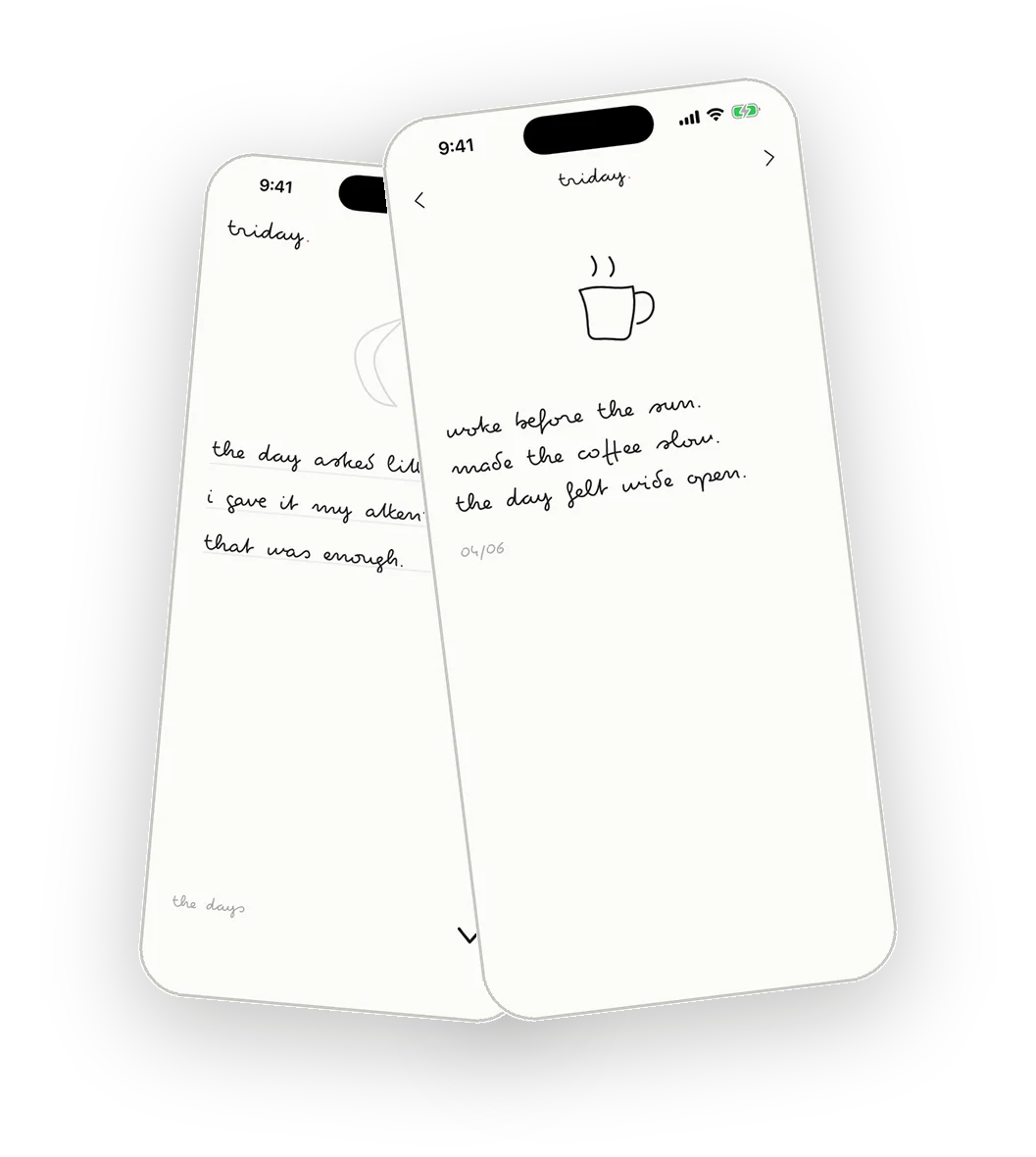
a three good things journal is a one-minute nightly habit: three things that went well today, each with a short reason why. it comes from a 2005 experiment by Martin Seligman and colleagues, where people who did it for a week were happier and less depressed up to six months later, mostly the ones who kept it going.1 it is the same backward look the stoics took at the close of the day. and it is, more or less, the whole of what triday does.
what a three good things journal is
the exercise was named and tested by positive psychologists, but the gesture is ancient. you sit down at the end of the day, you recall three things that went well, and you write them down, with a brief note on what caused each one. that is it. the "good things" can be large or, far more often, small. the point is not to manufacture a wonderful day; it is to notice the parts of an ordinary one that actually went right, because the mind, left alone, does not do this. it is built to flag what went wrong, the curt email, the thing you forgot, and to let the afternoon light slide past unrecorded. three good things, on purpose, drags your attention back across the day and makes it stop on what it would otherwise skip.
if that sounds like gratitude journaling, it is a close cousin, but not the same thing, and the difference is worth keeping. it is also, almost exactly, the stoic evening review pointed at the good instead of the faults. the same nightly look back, two thousand years apart.
how to keep one: the whole method
there is no app or notebook you need to buy to start; you can do it on a scrap of paper tonight. the method, in full:
- at the end of the day, write three things that went well. not the three most important things. the three that, looking back, actually went right.
- for at least one, add the cause. a few words on why it went well, or what part you played: "because I finally made the call," "because I let the silence sit instead of filling it." this is the working part, not decoration. the cause is what makes you re-enter the day and look at it, rather than just listing it.
- keep it short, and keep it most nights. a minute is plenty. the research is clear that the benefit lives in the keeping-up, not in any single profound entry, so the habit you can do tired beats the elaborate one you abandon.
- let the lines be true. some nights all three will be genuinely good. some nights "good" will be a stretch, and you can let one line just be what was real. the practice survives an honest entry; it dies on a forced one.
what to write: real examples
the single biggest thing that stops people is the suspicion that their three things are too small to count. they are not too small. here is how mundane a real entry is allowed to be:
the soup was good. finished the report and it felt clear for once. the light at six was unreal.
one small pleasure, one thing that went right, one bit of beauty noticed almost by accident. add a cause to one of them and it deepens without getting longer: the report felt clear because I started it before checking email. that is a complete, effective three good things entry, and a year from now it will hand you back the whole evening. if even three feels like too much on an empty night, here is the version for when you do not know what to write.
almost nothing is too ordinary to count. the ordinary days were the life.
why three, and why "good" is really "true"
why three? because three is small enough to manage on a tired night and large enough to make you choose. you cannot fit a whole day into three lines, so you have to decide what the day's good actually was, and that small act of choosing is most of the exercise. one thing is a reflex; three is a quiet review.
and a gentle amendment to the original, learned from the people for whom forced positivity backfires: read "good" as "true." the stricter versions of this practice ask you to be grateful or upbeat on schedule, and on a genuinely hard day that can feel like a small lie you tell before sleep. triday's version asks only that the three lines be honest. on most days the good will be there and the gratitude will be real because you did not force it. on the hard days, one line can simply be the hard thing, named once, and the page stays true. there is real evidence that the honest version is the more durable one.
does it actually work?
honestly, and modestly, yes. in the 2005 study the three-good-things group were measurably happier and less depressed at one, three and six months.1 the caveats are real and worth keeping: the durable benefit was concentrated in the people who kept doing it on their own, the sample was self-selected volunteers, and later replications have been more mixed. the careful summary is that the effect is small, and real, and that turns out to be enough. it is not an antidepressant and should never be sold as one. for the rigorous protocol and who it has and has not been tested on, Greater Good in Action keeps the best version.2 for the fuller story of the science, and why it works at all, we have written it up separately.
write three things that went well today. for at least one, add why. let them be small, let them be true, and do not reach for impressive. then close the book. that is the whole exercise the study tested, and the only part that matters is whether you are still doing it next month.
triday is the app form of it
triday is, almost literally, a three good things journal with the edges sanded off: three lines about your day, dated, and then closed. there is no streak to lose, no AI reading the entries, no account, and a price of about $1.24 a month, billed $14.99 once a year, a fraction of what the category charges, because a one-minute habit you might keep for years should not come with a heavy meter or a punishment. it reads "good" as "true," so it has room for the hard day, and it resurfaces your lines a year later, which is the quiet payoff the original exercise never had. you do not need triday to keep a three good things journal; a scrap of paper works. but if you want the smallest, most honest version of it to live in your pocket and hand the days back to you later, that is the whole of what it is.
- The foundational study: Seligman, M. E. P., Steen, T. A., Park, N., & Peterson, C. (2005). Positive psychology progress: empirical validation of interventions. American Psychologist, 60(5), 410-421. Writing three good things each night, with a cause, for one week raised happiness and lowered depressive symptoms at follow-ups up to six months, with the durable gains concentrated among those who kept the exercise up on their own. ↗
- For the rigorous step-by-step protocol and its caveats, the best resource is Greater Good in Action (UC Berkeley), "Three Good Things," which sets the practice out in detail and notes who it has and has not been tested on. ↗
questions
what is a three good things journal?
a nightly habit where you write three things that went well that day and, for each, a short note on why it went well. it comes from the positive-psychology exercise tested by Seligman and colleagues in 2005, and it is the same gesture as the older stoic evening review: a deliberate look back at the day before you let it go.
how do you keep a three good things journal?
at the end of the day, write three things that went well. for at least one, add a few words on the cause, why it happened or what part you played. keep it to a minute, do it most nights, and let the lines be true rather than impressive. that is the whole method.
what should I write in a three good things journal?
small, real, specific things. "the soup was good." "finished the report and it felt clear." "the light at six was unreal." the cause matters more than the size: "the call went well because I let the silence sit." examples beat instructions here, and almost nothing is too ordinary to count.
is a three good things journal the same as a gratitude journal?
close cousins, not identical. gratitude can point at anything you are thankful for, including things you had no hand in. three good things leans toward the day you actually lived, and often the part you played in it. we compare the two, honestly, here.
does keeping a three good things journal actually work?
in the 2005 study, people were happier and less depressed up to six months later, but the lasting benefit was concentrated in those who kept it up, the sample was self-selected, and later replications are mixed. the honest size is small but real. the full evidence is here.
the journal of a small, quiet diary app. we cite primary sources and report effect sizes honestly, and we don't make medical claims. how we write & what we won't say →