what to write in a journal when you don't know what to write: the three things that were your day
the problem was never that you had nothing to say. it was that the blank page asked for a performance, at 11pm, from someone who was just trying to go to bed.
it's a little past eleven. the page is open, the paper kind, or the glowing app kind, it doesn't matter which, and the cursor is sitting there, blinking, waiting for you to be interesting. and you have nothing. not nothing happened; you were alive all day, things happened. but nothing that seems worth writing down, nothing shaped, nothing that would survive being put into a sentence. so you sit in that small, specific panic, the one that has a name nobody says out loud: what to write in a journal when you don't know what to write. after a minute you close the page and tell yourself tomorrow.
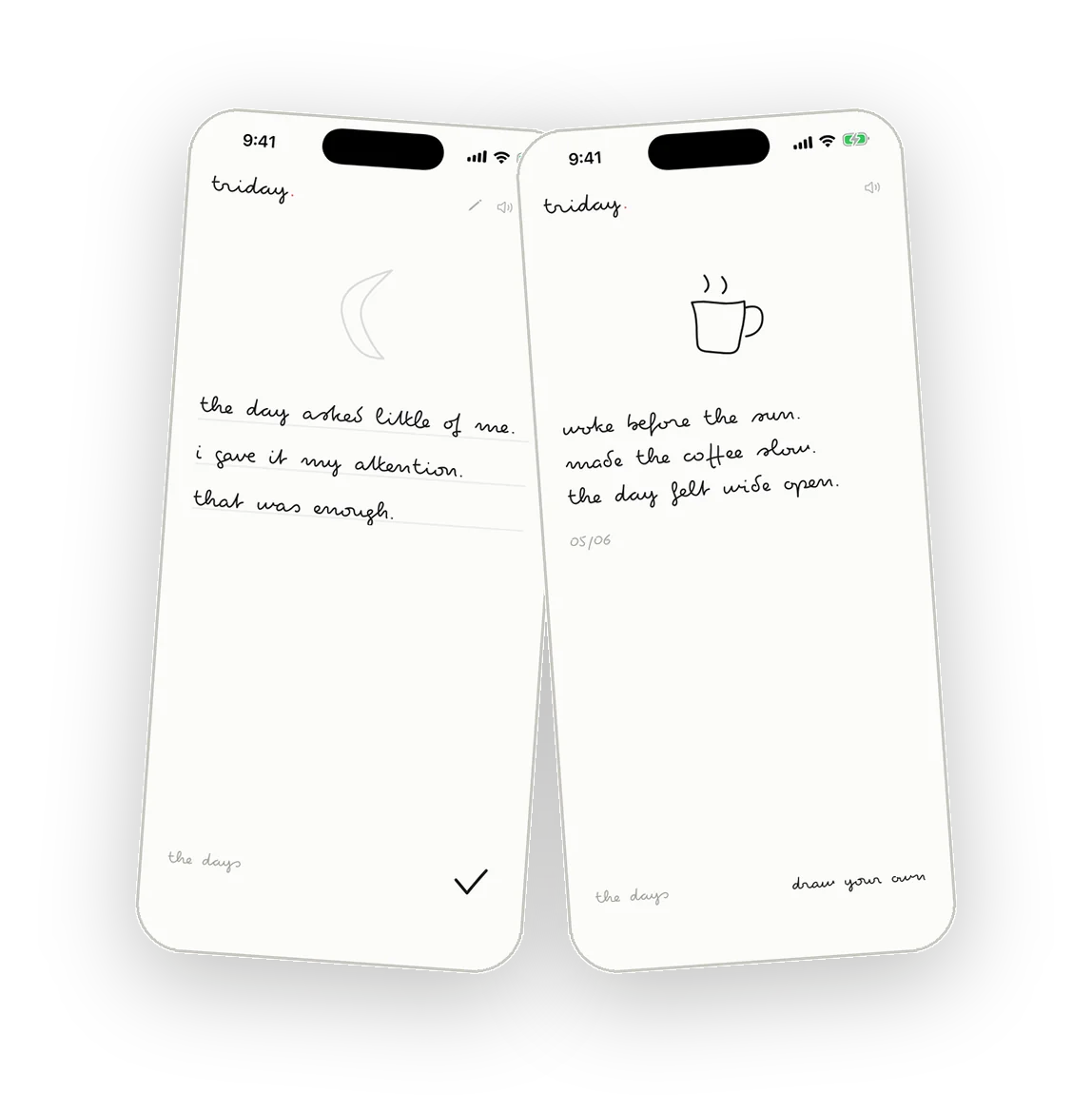
here is the thing to understand first, before any method: the blank page is the enemy, not you. you are not bad at this. you did not run out of life to report. what to write when you don't know what to write is simply the three things that were your day, short, true, and not necessarily good. not a feeling examined to its root. not something you're grateful for. three plain lines about what the day actually was, and then you close the book. that's the whole answer, and the rest of this is just permission to believe it.
why the blank page makes you freeze
an empty page is not a neutral thing. it asks a question, silently, and the question is so, what have you got? it wants something worthy of all that white space. it wants insight, or a feeling well described, or at least a day with a clear shape to it. most days don't have a clear shape. most days are errands and weather and a conversation that didn't quite land. faced with a page that seems to want literature, the honest report, "nothing much, tired, the usual", feels too small to bother writing, so you write nothing instead.
this is why "just journal anything" is not the kindness it sounds like. told to a fresh, rested person it's fine. told to a tired person at the end of a long day, "write whatever you want" is not freedom. it's a blank brief with no edges, and a blank brief is the hardest assignment there is. the open page doesn't lower the bar. it removes the bar entirely, and then you have to invent one, every night, which is exactly the work you don't have energy for. the apps that hand you fifty prompts are trying to solve this, and they're solving the wrong half: the problem was never a shortage of questions. it was the size of the room.
it doesn't have to be good. it has to be true and short.
so here is the permission, and it's worth saying flatly. what you write tonight does not have to be deep. it does not have to be wise, or grateful, or beautifully phrased, or about your feelings at all. it does not have to be anything a stranger would find interesting, because no stranger is going to read it. it has to be two things only: true, and short. that's the entire bar, and it's low on purpose, because a bar you can clear on your worst night is the only bar you'll keep clearing.
drop "good" and almost everything that was hard gets easy. you don't have to find the meaning of the day. you just have to find the day. you don't have to feel anything in particular about the soup; you just have to remember there was soup, and that it was good. the smallest, most literal noticing counts. it counts more than the grand entry you can't write, because the grand entry stays unwritten and the small one gets kept.
the one method: three lines about what the day was
so, concretely. at the end of the day, write down three things that were your day. not the three most important things, that's another performance. not the three things you're most grateful for, that's a different exercise with its own pressure. just three short lines that, read back in a year, would set you down again roughly where you stood today. then close it. that's the method, all of it.
three is the number because it's small enough to do tired and large enough to make you choose. you can't fit a whole tuesday into three lines, so you have to decide what the tuesday was, and that quiet little choosing is the only "depth" the practice needs. it does the thinking for you, without ever asking you to sit at a blank page and think.
and to break the spell that says the lines have to be momentous, here is how mundane they are allowed to be. genuinely this small:
- the soup was good.
- R didn't text back.
- the light at six was unreal.
that's a real entry. it is enough. one good thing, one small ache, one bit of weather noticed almost by accident, and a year from now those three lines will hand you the entire evening back, the kitchen, the phone face-down on the counter, the gold going long across the floor. you didn't have to perform anything. you just had to write down what was there.
it doesn't have to be good, or deep, or grateful. it has to be true, and short, and that turns out to be enough.
three small questions for a truly empty night
and if some night even that comes up blank, if you genuinely can't find three things, because the day was a fog and nothing surfaces, you don't need a list of fifty prompts. you need three gentle ways back in. pick whichever one finds something first:
- what did your body do today? where you went, what you ate, who you saw, what your hands touched. the most literal report there is, and it always has an answer.
- what's the last thing you remember noticing? not the most important thing, the last small thing that caught your eye. a face, a smell, the temperature, a sound. start there.
- what would you tell one person about today, in a sentence? the version you'd say out loud to someone who asked "how was it?", before you tidied it up. write that.
one of those will catch. and the moment you've got one true line, the other two tend to arrive, because you've stopped trying to write a journal and started just describing your day, which is a thing you already know how to do.
why the smallness is the whole point
it's tempting to treat this as a beginner's version, three lines to get you going until you graduate to "real" journaling. it isn't. the smallness is not a compromise; it's the feature. a thing you can do on your worst night is the only thing you'll still be doing in a year, and almost everything the research likes about reflective writing depends on actually keeping it up rather than on any single profound entry. in the best-known study of the "three good things" practice, the gains that lasted six months belonged mostly to the people who quietly kept the habit going on their own1, which tells you the durable thing was never the depth of one night. it was the return.
so the page that demands a performance is the page that ends up in the drawer, and the three short lines you can write half-asleep are the ones that survive the year. if you want the longer argument for why this small, dated, deliberately-unambitious habit outlasts both the diary and the open journal, it's here. and if part of what's freezing you is the little streak counter waiting to punish the night you miss, that's its own quiet sabotage. we made the case against it separately.
don't try to write a journal. just answer one question, "what did i actually do today?", and let three short lines fall out of it. the soup, the unreturned text, the light at six. true, not good. then close the book. that's the whole thing, and a year from now it will hand the day back to you.
the night you don't know what to write is not the night to write nothing. it's the night the method is for. three things that were your day, true and short and a little dull, is the entry you can manage when you have nothing, and the entry you can manage when you have nothing is, quietly, the only one that ever adds up to a kept year. that's the practice. it is, more or less, the whole app.
- In a randomized, placebo-controlled study, people who wrote three good things that went well each day (and why) for one week were happier and less depressed for up to six months, but the authors found the lasting benefit was concentrated among participants who kept doing the exercise on their own beyond the assigned week, not in the one-week dose itself. Seligman, M. E. P., Steen, T. A., Park, N., & Peterson, C. (2005). Positive Psychology Progress: Empirical Validation of Interventions. American Psychologist, 60(5), 410–421. ↗
questions
what should I write in my journal when nothing happened?
write the small, literal things, because "nothing happened" almost always means "nothing dramatic happened," not that the day was empty. what you ate, who you spoke to, the weather, the last thing you noticed. three plain lines about an ordinary day are exactly the kind of entry that's most worth having later; the boring tuesdays are the ones you can't reconstruct from memory.
what do I write in a diary every day?
the same three things, every night: what your day actually was, in short true lines, not what it should have been. you don't need a new prompt each day, the smallness and the sameness are what make it survivable. a few dated lines about the day is the oldest and most durable form of the habit, older than the open-ended journal by a couple of thousand years.
how do I start journaling if I don't know what to say?
lower the bar until it's almost insulting, then start there. don't write a journal, answer one question, "what did I do today?", and let three short lines fall out. they don't have to be good, deep, or grateful; true and short is the entire requirement. the version you can do on a bad night is the only version that lasts.
the journal of a small, quiet diary app. we cite primary sources and report effect sizes honestly, and we don't make medical claims. how we write & what we won't say →