the streak is the thing killing your journal, and why streaks backfire
the little counter turns a quiet evening habit into a number you perform to avoid losing. this is the case, from conviction, and with the evidence, for why streaks backfire, and why a journal you can miss is the only kind that lasts.
there is a small number in the corner of the screen, and it is counting. seven. eight. nine days in a row you opened the app and wrote your three lines, and the number grew, and somewhere in the second week you stopped writing for yourself and started writing for it. that is the quiet switch the streak counter flips, and it is why streaks backfire on a habit you actually wanted: a thing you did because it was good for you becomes a thing you do so the number does not go back to zero. and then, one ordinary tuesday, you are tired, or away, or just human, and you miss. the number resets. and the awful part, the part the whole industry is built on, is that you do not pick it back up the next night. you are done.
here is the case in three lines, since that is the house style. streaks backfire because they convert an intrinsic habit into a number you can only lose. loss aversion keeps you returning in the short term, but it also makes the first missed day feel like total failure, when the missed day, the research says, barely dents the habit at all. the gap between what is true and what the counter tells you is exactly where the habit dies.
what the little number actually does
a streak is a clever piece of machinery, and it is worth seeing it clearly before you decide it is your friend. it takes a behaviour (writing, stretching, a language lesson) and bolts on a second, separate goal: do not break the chain. the first goal is intrinsic. you write because the day deserves a sentence, because a year unrecorded slides past like water. the second goal is extrinsic, and it is about the number, not the day. and the trouble with bolting a number onto something you already cared about is that the number starts to do the wanting for you.
psychologists have a name for this, and it is not flattering. it is the overjustification effect: give someone an external reward for a thing they already did from the inside, and the inside reason can quietly wither, crowded out by the outside one.1 the streak is a reward you give yourself every night just for showing up, a little hit of kept it, and over weeks it can quietly replace the real reason. you stop asking what were the three things that were today? and start asking did i keep the streak? those are not the same question. one is about your life. the other is about a tally.
why a number you can lose is the wrong number
now add the second mechanism, which is the cruel one. a streak is not just a count; it is a count framed as something you possess and could lose. and we are not symmetrical creatures about loss. the finding is old and robust: a loss looms larger than an equivalent gain, losing twenty pounds stings more than finding twenty pleases, which is why we will work harder to keep what we have than to get more of it.2
app designers know this, and they build on it on purpose. a streak works as engagement because it leans on loss aversion: the longer the chain, the more it would hurt to break it, and so the more nights you return, not out of love for the thing, but out of dread of the reset. snapchat made a whole social currency out of the little flame between friends. duolingo built the green owl and the day count into the core of its retention loop. that is not an accident or a side effect; the streak is the retention strategy. and the most honest tell of all is that these apps now sell you a streak freeze, a way to pay, in coins or attention, to not lose the number on a night you can't perform. you do not sell insurance against losing a thing unless losing it is the lever you are pulling.
none of this is care. it is design. a streak does not know whether your tuesday was worth recording; it only knows whether you fed it. and on the night you cannot (the funeral, the flu, the flight that landed at two in the morning), the counter does not say rest, you'll be back. it says zero. it punishes you for being a person on the exact night you most needed the small kindness of a habit that waits.
a habit you can lose in a single night was never a habit. it was a hostage situation with a nice font.
the missed day that does not actually matter
here is the fact that quietly demolishes the whole streak logic, and almost no one who sells you a chain will tell it to you. in 2010, phillippa lally and her colleagues followed ninety-six people forming a new daily habit and watched, day by day, how automatic it became. the headline that escaped into the world was the famous figure, a median of about sixty-six days to automaticity, though the real range ran from eighteen days to two hundred and fifty-four, so it was never one tidy number to begin with.3 but the line that matters for you is buried deeper: missing a single day did not materially affect the habit-formation process. one missed opportunity barely dented the climb toward automaticity, and performing the behaviour again the next day put people right back on the curve. the habit, it turned out, is forgiving in exactly the way the streak is not.
it is one small study, and worth holding lightly: ninety-six volunteers, self-reported, a single behaviour each. but the direction is the thing, and the direction is clear: a habit is built by the long accumulation of mostly-yes, not destroyed by the occasional no. the streak counter inverts this. it tells you the missed day is catastrophic, back to zero, start again, when the evidence says the missed day is closer to a rounding error. you are being made to feel you failed at something the science says you barely interrupted.
the one missed night, and what you do with it
so if a single miss is harmless, why do people actually quit? not because of the missed day. because of what the reset does to the day after. there is a name for this too, from the unglamorous research on dieting. herman and polivy described the what-the-hell effect: the dieter who has one biscuit, decides the day is already ruined, and eats the entire packet, not because of the biscuit, but because of the story the biscuit triggered. i've broken it, so it's broken, so why bother.4 the broader clinical term is the abstinence-violation effect: it is not the lapse that wrecks the project, it is the collapse of self-image that follows the lapse.
the streak is a what-the-hell machine. it takes the smallest possible stumble, one night, one zero, and hands you the exact story that turns a stumble into a stop. the counter said you had a forty-day thing. now it says you have nothing. and so you have nothing, and the notebook goes in the drawer with all the others, and the streak that was supposed to protect the habit is the precise thing that killed it. people do not abandon journals because the missed night damaged the habit. they abandon them because the streak told them the missed night meant they had already failed, and the cheapest thing to do with a failure is to walk away from it.
this is not an argument against consistency. consistency is the whole point: the year only fills in if you keep at it. it is an argument against a specific tool that pretends to serve consistency while quietly making the first missed day fatal. you can want to write most nights and still refuse to be punished for the nights you don't.
a habit you are allowed to miss
so what replaces the chain? not nothing. the answer is not to stop caring whether you wrote. the answer is to build the missed day into the habit from the start, as a feature, not a failure. the rule worth keeping is not never miss; it is closer to never miss twice: one skipped night is a day off, two in a row is the start of a drift, and the only thing that ever needed your attention was coming back, not keeping a flawless record.4 a journal you are allowed to miss is the only journal you will keep for years, because it is the only one whose worst night, the night you forget, does not also become its last.
think about what you actually want from the habit, ten years out. you do not want a clean chain of unbroken numbers; nobody rereads a streak. you want the days. you want to open a quiet record and find the ordinary tuesday you would otherwise have lost, the way a diary keeps the day a journal would only interrogate. and a record like that does not need to be perfect to be precious. the gaps are part of the truth of a life. the week you missed because something hard was happening is, itself, a true entry about that week. a streak cannot hold a gap; it can only register it as failure. a real account of your days holds the gaps the way a face holds its lines.
what we built instead
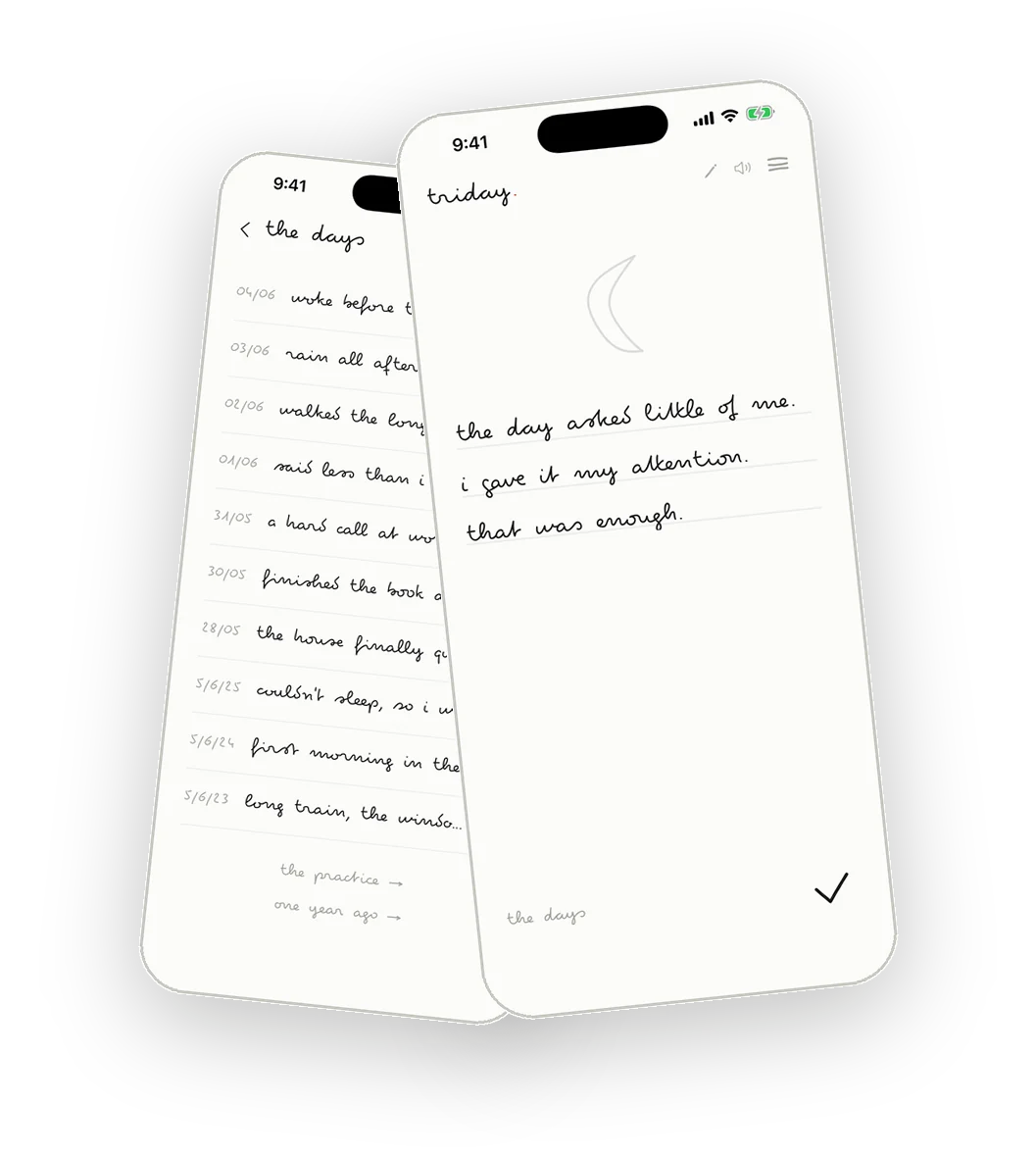
this is, more or less, the whole argument behind the app these essays come from, so let me say it plainly and then stop. triday has no streak counter. there is no number in the corner, no chain to break, no green flame, no penance for the night you don't write. not a streak to protect, only days you were here for. you write the three things that were your day, and you close it, and if tomorrow you don't, nothing punishes you and nothing resets. the day after that, you just write again. the habit was never the chain. the habit was the writing, and the writing survives precisely because we refused to put a number on it you could lose.
that is the quiet bet of the thing: that a habit small enough to do on your worst night, and forgiving enough to miss without shame, will still be with you when every streak you ever started has long since reset to zero and been abandoned. it asks for less than a minute, and nothing on the nights you can't. there is no chain here to break, only, a year from now, a record of the days you were actually here for, gaps and all.
write the three things that were today, and notice you are not doing it for a number. there is no chain in the room. if you missed last night, you missed last night. it does not subtract from this one. just find the three things and close the book. and if you don't know what counts, start with the version for when you don't know what to write.
- On the overjustification effect, that an external reward for an already-intrinsically-motivated behaviour can undermine the original interest: Lepper, M. R., Greene, D., & Nisbett, R. E. (1973). Undermining children's intrinsic interest with extrinsic reward: A test of the "overjustification" hypothesis. Journal of Personality and Social Psychology, 28(1), 129–137. A foundational demonstration; effects vary by reward type and context. ↗
- On loss aversion, that losses loom larger than equivalent gains: Kahneman, D., & Tversky, A. (1979). Prospect theory: An analysis of decision under risk. Econometrica, 47(2), 263–291. The asymmetry between losing and gaining is the mechanism a streak counter is built to exploit. ↗
- Lally, P., van Jaarsveld, C. H. M., Potts, H. W. W., & Wardle, J. (2010). How are habits formed: Modelling habit formation in the real world. European Journal of Social Psychology, 40(6), 998–1009. 96 volunteers; median time to automaticity ~66 days (range 18–254). The authors report that missing a single opportunity to perform the behaviour did not materially affect the habit-formation process. One small self-report study, so treat the exact numbers lightly, but the direction is clear. ↗
- On the what-the-hell effect / abstinence-violation effect, that a single lapse can trigger the collapse of a whole effort, and that recovery (not perfection) is what matters: Herman, C. P., & Polivy, J. (1984). A boundary model for the regulation of eating, in A. J. Stunkard & E. Stellar (Eds.), Eating and Its Disorders (pp. 141–156). New York: Raven Press; the broader abstinence-violation effect is from Marlatt & Gordon's relapse-prevention work (1985). Demonstrated chiefly in eating and addiction research; applied here to habits by analogy. ↗
questions
do streaks actually work for building habits?
for a while, yes, that is what makes them dangerous. a streak drives engagement by attaching loss aversion to a behaviour, which keeps you returning in the short term. but the same mechanism makes the first missed day feel like total failure, and that is when most people quit. the habit-formation research (Lally et al., 2010) found that a single missed day did not materially affect the habit itself; the streak just convinces you otherwise.
does missing one day ruin a habit?
no. in a real-world study of habit formation, missing a single opportunity to perform the behaviour did not materially affect the process, people picked it back up the next day and stayed on the curve (Lally et al., 2010). what actually ends habits is the story we tell after a miss: that it is already broken, so why bother. the lapse is harmless; the giving-up is not.
why do journaling streaks make me quit?
because the streak reframes one ordinary missed night as a catastrophic reset, which triggers the what-the-hell effect: you decide the run is ruined and walk away. a journal you are allowed to miss avoids this entirely, there is no number to lose, so a skipped night stays a skipped night instead of becoming the last one.
the journal of a small, quiet diary app. we cite primary sources and report effect sizes honestly, and we don't make medical claims. how we write & what we won't say →