on this day a year ago, you wrote three lines
the app hands you back a day you'd lost, the worry that resolved, the small joy you forgot you had. but it only works if, a year ago, you wrote it down.
it was a tuesday, and the app showed me three lines i had no memory of writing. the dishwasher leaked again. p. called about her scan, it's benign. ate the last of the good bread on the step, sun out. on this day a year ago. and the strange part was not that i'd forgotten the dishwasher, or even the bread. it was that i had forgotten the scan entirely, the whole grey week of waiting i must have done, the relief when the call came, gone, sanded smooth. one line had kept it. without that line, the day would have been water.
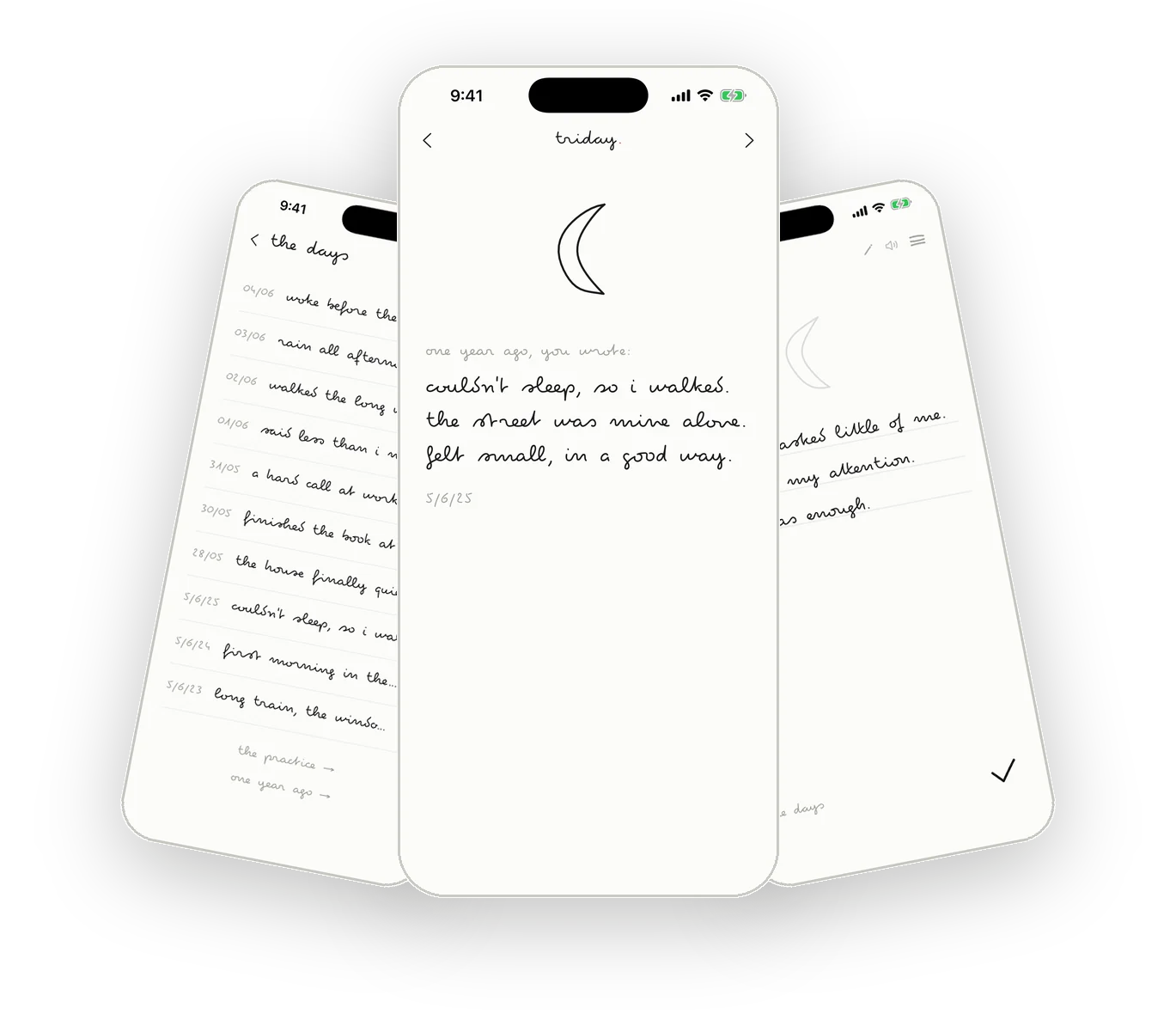
that small shock has a name now, more or less: on this day a year ago, the feature that resurfaces, tonight, exactly what you wrote one year ago tonight. not a memory you summoned. a day handed back to you, in your own handwriting, that you could not have retrieved on your own. it is the quietest thing an app can do, and it is, i think, the reason to write anything down at all.
the day you'd already lost
we are supposed to forget our days. that is not a flaw in you; forgetting is most of what a working memory does, and a brain that kept every tuesday would be a brain that couldn't find anything. but there is a difference between letting a single day go and watching a whole year close over without a mark, and most of us, without meaning to, do the second thing. ask yourself what happened on this day a year ago and you will get nothing. not a blank you can fill in. a blank with no edges.
you have met the other kind of resurfaced memory, the one your phone does on its own: a photo from four years back, surfaced by an algorithm, one you did not choose and did not always want, the holiday with the person who left. that is a machine handing you pixels. the year-ago line is a different thing. it is words, not pictures; chosen by you, not picked by a feed; the day as you understood it, not as a camera happened to catch it. one is your past edited by software. the other is your past in your own account of it.
part of why is mechanical, and we've written about it elsewhere, the reason time speeds up as you get older is, in large part, that fewer days get encoded as anything distinct, so there is less of them to remember, so the year reads short. an ordinary day, lived and not noticed, leaves almost nothing behind. the year-ago line is a window memory alone will not give you, because the day it points at was never really stored. you didn't forget it. it was never written anywhere, except, if you were lucky, in three lines, by you, before you went to sleep.
the ache and the comfort, both
two things happen when the line comes back, and they arrive together.
the first is comfort, and sometimes it is enormous. you read a line from a hard day, can't stop the worrying, didn't sleep, told no one, and you are reading it from the far side. you know how it came out. the thing you were so sure would not be survived was survived; here you are, a year on, holding the proof in your hand. the worry that felt permanent turns out to have had a date, and an end you couldn't see from inside it. there is a particular mercy in being shown, in your own words, that you have already lived through worse than tonight.
the second is stranger and quieter. you read a line from an utterly ordinary day, nothing much. walked the long way. d. laughed at the thing about the cat., and it lands harder than the hard one. because it is gone, completely, and now it isn't. a tuesday you would have sworn contained nothing turns out to have held a walk and someone laughing, and you get it back, and you understand for a second that the ordinary days were the life. that is the ache: not that the day was sad, but that it was sweet and you'd already mislaid it. the app does not make the day precious. it just stops you losing it, and an ordinary day you don't lose turns out to have been precious the whole time.
a hard day, and you survived it. an ordinary day, and it was the whole point. both were waiting in three lines.
the only catch, and it's the whole thing
here is the one honest catch, and everything turns on it: you cannot reread what you never wrote. on this day a year ago has nothing to hand you if, a year ago, the evening went by unrecorded. the feature is not magic. it is just a faithful return of whatever you put in, and on the nights you put in nothing, it returns nothing, politely, forever.
which reframes the whole nightly minute, and reframes it gently. the three lines you write tonight are not really for tonight. tonight you know what happened; you don't need the note. the lines are a small parcel addressed to yourself, a year out, to the person who will have forgotten this exact tuesday and would give a good deal to have it back. that is the entire transaction. a minute now, in exchange for a day later that you would otherwise never see again. it is, as far as i can tell, the best rate of return on a minute that exists.
and the rate compounds, quietly, which is the part the research can speak to without overstating it. in a randomized study, people who wrote three good things each night were measurably happier months later, though, honestly, the lasting benefit was concentrated among those who simply kept it up, who let the small habit run.1 the year-ago line works the same way. one entry is a nice surprise. a year of entries is a second copy of your life, and the only way to have one a year from now is to have started keeping it, in small pieces, a year ago, which is to say, tonight.
write the three things that were today. not the most important three, the three that, read back in a year by someone who has forgotten this whole day, would set them down again inside it. then close the notebook. you are not writing for yourself tonight. you're writing for the stranger you'll be next june, who would love to have this tuesday back. if even three feels like too much, here's what to write when you don't know what to write.
why a small app bothers to do this
this is, quietly, why triday surfaces a year ago at all, and why it asks for three lines and not three pages. the three lines are the affordable version of the gift, small enough to actually keep on a tired night, which means they will still be there in a year, which is the only version of the gift that ever arrives. a beautiful long entry you abandon by february leaves you nothing to resurface. three honest lines, kept up, leave you a year, day by day, waiting.
there is no streak counter in this, and that is on purpose, a number to protect is the thing that makes people quit, and the days you miss aren't a failure, just days with no note. what's left is plainer and kinder: a small, dated, honest account of your days, written a minute at a time, so that a year from now there is something there to find. on this day a year ago, you wrote three lines. on this day next year, you'll be glad you wrote tonight's.
- On the durable benefit being concentrated among those who kept the practice up: Seligman, M. E. P., Steen, T. A., Park, N., & Peterson, C. (2005). "Positive Psychology Progress: Empirical Validation of Interventions." American Psychologist, 60(5), 410–421. People who wrote three good things each night for one week were happier and less depressed at the 1-, 3-, and 6-month follow-ups; the authors note the lasting gains were largely concentrated among participants who chose to continue the exercise on their own. ↗
questions
what is the "on this day" feature?
it resurfaces what you wrote on this exact date in past years, most powerfully, on this day a year ago. instead of an algorithm-curated social memory, it hands back your own three private lines from a day you'd otherwise have forgotten. it only shows you what you actually wrote, so the habit and the feature are the same thing.
why does seeing an old entry from a year ago feel so powerful?
because the day was never really stored in memory in the first place, an ordinary day leaves almost nothing behind, which is part of why time seems to speed up as you get older. the year-ago line gives you back a day you couldn't have retrieved on your own. a hard day shows you survived it; an ordinary day turns out to have been the whole point.
how do I see what I wrote a year ago?
you have to have written it. the feature is a faithful return of whatever you put in, so a year ago tonight needs an entry for tonight to resurface it. the only way to read your words from a year ago is to have spent a minute writing them, which is why three short lines a night, kept up, is the practice worth keeping.
the journal of a small, quiet diary app. we cite primary sources and report effect sizes honestly, and we don't make medical claims. how we write & what we won't say →