the years grow hollow: why does time go faster as you get older
a child's summer is endless; an adult's year is gone by the time you've noticed it starting. the reason isn't only that the years are shorter fractions of your life. it's that you stopped laying anything down.
there is a moment, somewhere in your thirties or forties, when you catch yourself saying it out loud. where did the year go. you say it at christmas, at a birthday, at the turn of a season you swear only just arrived. and the strange thing is that the days did not feel fast while you were inside them. it is only looking back that the year seems to have been folded in half and then in half again, until the whole of it fits in a sentence. a child does not say where did the year go. a child says is it time yet, and means it, because for a child the gap between now and the thing they are waiting for is an ocean. somewhere between that ocean and this folded sentence, time changed speed.
so here is the question, plainly, and then the honest answer. why does time go faster as you get older? there are two reasons, and most articles give you only the first. one: each passing year is a smaller fraction of the life you've already lived, so it weighs less. two, and this is the one that actually matters: childhood is crowded with first times, and first times lay down dense memory, while a routine adult year leaves almost no trace, and a year that left no trace reads, in the rear-view mirror, as if it barely happened.
the year that keeps shrinking
the first explanation is old, tidy, and only half true. it is usually called the proportional theory, and it goes like this. to a one-year-old, a year is the whole of existence. to a ten-year-old, a year is a tenth of everything they have known. to a fifty-year-old, that same year is a fiftieth, a thin slice off a thick loaf. if you feel each year against the length of the life behind it, then of course the years seem to shorten as the life lengthens. the math is merciless and clean.
the idea is usually traced to a nineteenth-century french philosopher, Paul Janet, who proposed in 1877 that the apparent length of a span of time is measured against the total time already lived.1 but it reached most of us through William James, who took it up in his Principles of Psychology in 1890. james wrote about the "foreshortening of the years", the way that, as we age, the days and weeks "smooth themselves out" and "the years grow hollow and collapse." his own diagnosis went deeper than the arithmetic, and we'll come back to it, because james blamed not the shrinking fraction but "the monotony of memory's content", the fading of new, distinctly remembered impressions.2
and that is the tell. the proportional theory is the explanation people reach for first because it sounds like physics, but treat it as a complete answer and it falls apart in your hands. if every year were simply a fixed fraction shorter than the last, your sense of time would shrink on a smooth curve, the same in june as in a year you fell in love, the same in the year nothing happened as in the year everything did. but that is not how it feels. some years are vast and some are a blur, and they are not vast or blurry in proportion to your age. the year you moved cities felt enormous. the year after, in the new city with the new routine settled, was gone like smoke. the fraction was nearly the same. the felt length was not. so the proportion is real, and it is doing some of the work, but it is not the engine. the engine is memory.
why the engine is memory, not arithmetic
here is the better explanation, and it has a quiet, almost unbearable implication once you see it. we do not feel the length of a stretch of time while it is passing. we estimate it afterward, and the way we estimate it is by how much we remember from inside it. a span thick with distinct memories reads as long. a span with nothing to grab onto reads as short. time, in retrospect, is measured in markers.
now think about what a child's year actually contains. it is almost nothing but markers. the first day of school. the first time on a bicycle without the hand on the seat. a new word, a new street, the first time the sea. a child is doing things for the first time more or less constantly, and the brain treats novelty as worth keeping. it encodes the new densely and the familiar barely at all. so a child's year lays down a thick stack of distinct, dated, vivid memory, and read back, that thick stack is a long year. the endlessness of a childhood summer is not a trick of innocence. it is the felt thickness of a season in which almost everything was new.
now think about a year at forty-three. you have driven that commute a thousand times; you do not encode the thousand-and-first. you have had ten thousand ordinary dinners; this tuesday's does not get its own file. the adult brain, having seen most of it before, runs on a kind of efficient autopilot, and autopilot leaves no diary. the year was full, full of work, of love, of small griefs and small wins, but it was full of the familiar, and the familiar does not get written down inside you. so when you reach december and ask where the year went, the honest answer is: nowhere. it went exactly where the other years went. you just didn't keep any of it, so there is nothing to weigh, and a year you cannot weigh feels weightless.
a child's year is thick with first times, and first times are what memory keeps. the adult year runs on autopilot, and autopilot leaves no diary.
the science writer Claudia Hammond gave the cleanest version of this in her book Time Warped, where she calls it the holiday paradox.3 think of a week somewhere new, a week of unfamiliar streets, strange food, things you'd never done. while you are in it, the week races by; you're absorbed, present, time flies. but afterward, looking back, that single week seems to have lasted forever, far longer than the three ordinary weeks that bracketed it at home. the paradox is that the same stretch can feel fast in the living and long in the remembering, and the reason is memory: novelty makes time fly in the moment and stretch in the memory, because it lays down so much to recall. the ordinary week is the mirror image, slow to live, then gone without a trace. most of adult life is ordinary weeks. that is why the decades compress.
the bump that proves it
if novelty is really the engine, there should be a fingerprint of it somewhere in the shape of a whole life's memory. and there is. ask people over forty to recall events from across their lives, and the memories do not come evenly. they cluster. there is a thick band of recollection from roughly the ages of ten to thirty, and especially the late teens and twenties, that stands proud of everything around it. psychologists call it the reminiscence bump, documented by David Rubin and colleagues in studies of autobiographical memory.4 the years you remember most vividly, decades later, are the years that were most crowded with firsts: first love, leaving home, the first real job, the friendships that formed who you'd become.
the reminiscence bump is the proportional theory's quiet refutation, sitting right there in the data. if time simply shrank as a fraction of your age, your earliest years should be the most vivid of all, they were the largest fractions you ever lived. but they are not the most vivid; the bump sits later, on the decade of maximum novelty, not the decade of maximum proportion. memory does not track how large a slice of your life a year was. it tracks how much of that year was new. the late teens and twenties bulge in memory for the same reason a childhood summer felt endless and a holiday week feels long in the rear-view: they were dense with first times, and density is the thing the mind keeps.
this is also, gently, why so much of life after thirty can feel like it is happening to someone on a moving train. not because nothing happens, plenty happens, but because the brain has filed most of it under "seen this before" and declined to make a separate copy. the bump ends roughly where the firsts thin out. william james was pointing at exactly this when he wrote, a century before the studies caught up, that the years grow hollow. a hollow year is a year with nothing encoded inside it.
an unrecorded year really does vanish
now the unbearable implication, said plainly. you cannot reminisce over a day you never encoded. the reason whole years go missing is not that they were empty; it is that nothing in them was marked, and an unmarked day leaves no edge for memory to catch. this is the difference between forgetting a day and never having kept it. a forgotten day can sometimes be recovered, a smell, a song, and it floods back. but a day that was never encoded in the first place is not lost. it is simply absent. there was never a file to misplace.
and here is where the merely interesting becomes the thing that should make you put the article down for a second. the years are not going to get less familiar. you are not going to un-learn your commute or make your tuesdays strange again by force of will. the novelty that thickened your childhood is, by the nature of a life, mostly behind you. you have already done most of your firsts. left to run, this only accelerates. every year you live makes the next year more familiar, and more familiar means less encoded, and less encoded means faster still. the decades do not compress at a steady rate. they compress at a compounding one. the hollowing, as james saw, feeds on itself.
none of this is a medical matter, and none of it is about anything going wrong with you. the foreshortening of the years is what a normal, efficient memory does with a life that has grown familiar. it is not forgetfulness to worry about. it is just the ordinary physics of a mind that has seen most of it before.
there are two levers, and one of them is small enough to pull tonight
so what do you actually do about it. you can't slow physics, and you wouldn't want to live in a permanent state of novelty even if you could. that is exhaustion, not richness. but if the felt length of your life is set by how much of it you keep, then there are exactly two levers, and they are both real.
the first is the one every article ends on, and it is true as far as it goes: seek novelty. take the different road home. learn the thing. say yes to the trip. break the routine often enough that the brain has to wake up and start encoding again, because a single genuinely new experience can do more for the felt length of a month than a dozen identical good ones. this works. it is also expensive, effortful, and impossible to do every day. you cannot make every tuesday an adventure, and you shouldn't try.
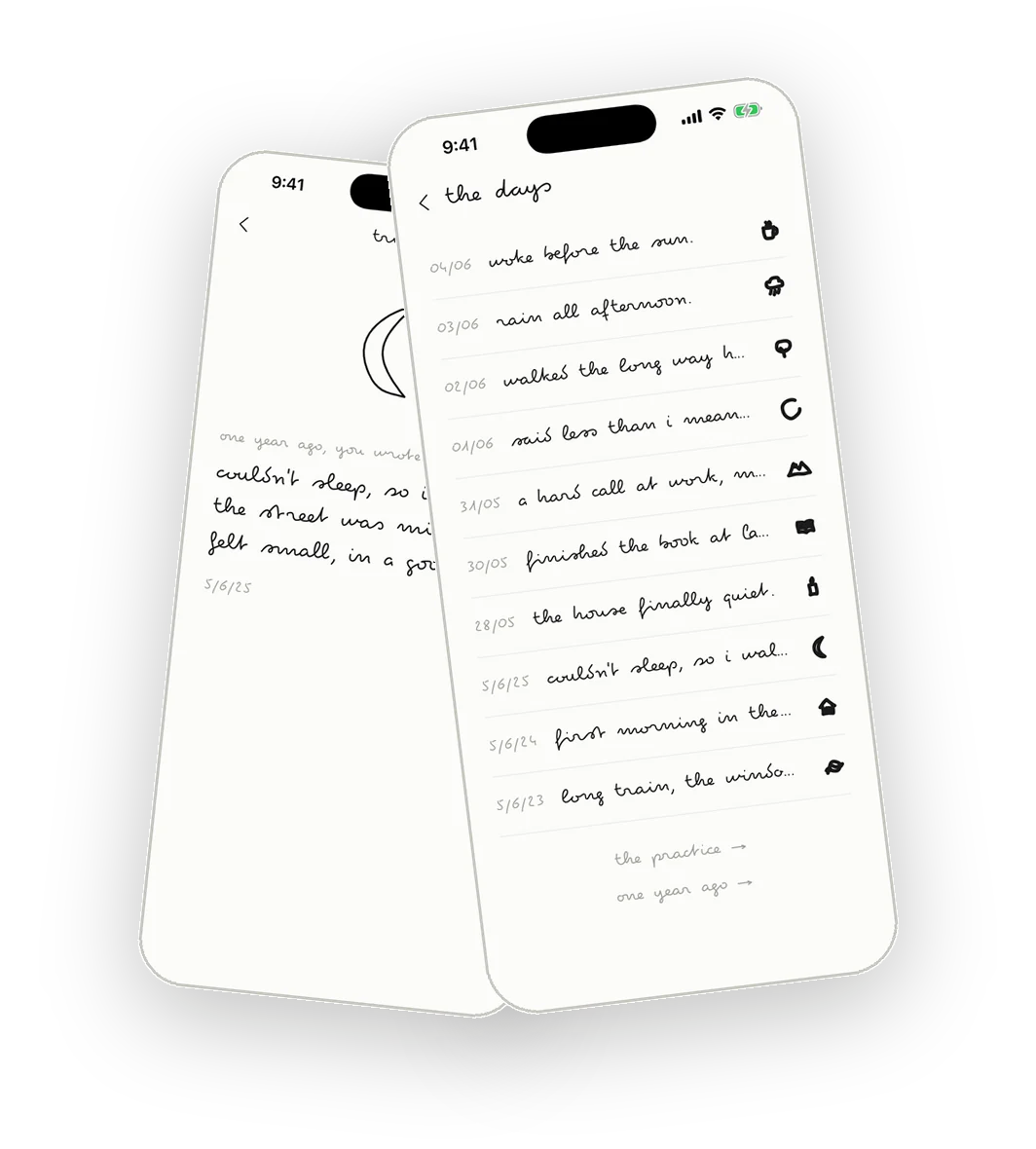
the second lever is the cheap one, and almost nobody names it, and it is the one this whole essay was walking toward. if the problem is that ordinary days leave no trace, then leave the trace deliberately. you don't have to make the day novel. you have to mark it. and the smallest possible mark, smaller than a diary entry, smaller than a photo even, is a few written lines, dated, about what the day actually was. not what you should remember. what you'd want set down again in front of you a year from now.
this is the part where i should be honest about what writing three lines does and doesn't do, because the brand here is honesty and the temptation to overclaim is enormous. it does not slow time down. nothing you write tonight changes how fast the clock moves or un-hollows a year already gone. the proportion still holds; the autopilot still runs. what recording changes is not the speed of time but what survives it. an unrecorded tuesday is gone for good. there was never a file. a tuesday with three honest lines against the date is a tuesday you can stand inside again. you didn't make the day longer. you made it recoverable. and over a year of them, you have done something the science quietly predicts: you have manufactured, on purpose, the markers that a familiar life stops making on its own.
three lines is enough to be a marker and small enough to actually do on a tired tuesday, which matters more than it sounds, because the practice that works is the one you keep, and the elaborate one dies by february. it borrows from the oldest version of the habit. it is, more or less, what the stoics did when they closed each day by going back over it, and it is the smaller, older thing underneath every diary and every journal, the three lines that survive the year when the long blank page does not.
before you sleep, write three lines about today, not the three most important things, not the three you're most grateful for, but the three that, read back in a year, would set you down again inside this exact day. the smell of it. the small thing someone said. then date it and close. you are not slowing time. you are leaving yourself a mark to find your way back to.
what it gives back
do this for a while and something happens that the arithmetic of the proportional theory cannot account for, because it is not about fractions at all. a year from tonight, you open to this date, and there is a tuesday waiting, small, dated, exact. you read three lines and the whole day reassembles around them: who you were that week, what you were worried about, the thing you'd completely forgotten and are now astonished you forgot. for a moment the year is not a folded sentence. it is a year again, with a tuesday in it you can stand inside. that is the thing the hollow years can't give you, and it is also, when you find it waiting, the quietest and most surprising gift the habit pays out.
time will still go faster as you get older. that part is not negotiable, and anyone who tells you a notebook will reverse it is selling you something. but there is a difference between a life that streams past unrecorded and one that leaves a thread you can follow back. the years grow hollow when nothing is kept in them. the cure is not to live faster, or harder, or to chase a permanent holiday. it is just to keep a little of each day, on purpose, while you still have the day, three lines and the minute it takes to write them, against the date, so that the year does not slide past unread, and a year from now there is something there to find.
- The proportional theory of time perception is generally traced to the French philosopher Paul Janet, who in 1877 ("Une illusion d'optique interne," Revue Philosophique) proposed that a span of time is judged in proportion to the total length of life already lived, so a year feels shorter the more years precede it. Janet's formulation reached a wide audience through William James, who names and cites him in the chapter referenced in the next note; for a modern scholarly account see John Wearden, "Paul Janet and Changes in the Apparent Speed of Passage of Time with Aging," Timing & Time Perception 10(3), 2022. ↗
- On the "foreshortening of the years": William James, The Principles of Psychology (1890), vol. 1, ch. XV ("The Perception of Time"), where James writes that in later life the days and weeks "smooth themselves out" and "the years grow hollow and collapse," credits the proportional idea to Paul Janet, and argues the deeper cause is "the monotony of memory's content", the fading of novel, distinctly remembered impressions. ↗
- On the "holiday paradox", that a novel stretch of time feels fast while lived but long in memory, because novelty lays down more to recall: Claudia Hammond, Time Warped: Unlocking the Mysteries of Time Perception (Canongate, 2012). ↗
- On the reminiscence bump, the clustering of autobiographical memories around adolescence and early adulthood in people over forty: Rubin, D. C., Wetzler, S. E., & Nebes, R. D. (1986), "Autobiographical memory across the adult lifespan," in D. C. Rubin (ed.), Autobiographical Memory (Cambridge University Press), pp. 202–221.
questions
why does time go faster as you get older?
two reasons. first, each new year is a smaller fraction of the life you've already lived, so it weighs less. but the bigger reason is memory: childhood is crowded with first times, which the brain encodes densely, while routine adult years run on autopilot and leave almost no trace. a year you didn't encode reads, looking back, as if it barely happened.
how do you make time feel slower?
you can't change the clock, but you can change what survives it. there are two levers: seek novelty (new places, new routes, genuine firsts wake the brain back up and lay down memory), and record the ordinary days so they leave a mark. the first is effortful and occasional; the second is small enough to do every night.
does journaling make time feel slower?
not literally, recording won't change how fast the clock moves. but the reason years vanish is that ordinary days leave no trace to remember them by. a few dated lines a night manufacture the markers a familiar life stops making on its own, so the days become recoverable instead of gone. it changes what survives time, not its speed. there's more on what that gives back here.
what is the reminiscence bump?
the reminiscence bump is the finding, documented by David Rubin and colleagues, that people over forty recall a disproportionate number of memories from roughly ages ten to thirty, especially the late teens and twenties. those were the years most crowded with firsts, which is why they stand out decades later, and it's good evidence that novelty, not proportion, is what memory keeps.
the journal of a small, quiet diary app. we cite primary sources and report effect sizes honestly, and we don't make medical claims. how we write & what we won't say →