how seneca closed his day: the stoic evening review, in plain language
when the lamp was out and the house had gone quiet, seneca went back over his whole day. he borrowed the habit from a man named sextius, and we have been keeping a version of it for two thousand years.
the lamp is out. the household has gone quiet, the day's noise done, the wife beside him fallen silent, knowing the habit by now. and in the dark, before sleep, a man lies on his back and goes back over his whole day. every word he said, everything he did, nothing skipped, nothing hidden. what did you do badly today. where were you better. what is still owed. only when the account is settled does he let himself sleep, and the sleep that follows, he says, is wonderfully deep.
the stoic evening review is what he is describing: a short, daily reckoning with the day just lived, done at night, alone, in the head or on the page. the man is Seneca, writing in the first century. it is the oldest reflective practice in the western tradition that anyone still does on purpose, and it survives, in stripped-down forms, in half the journals and apps you have ever quit. this is the plain-language guide to where it came from, what it actually asked, and how little of it you need to keep.
the short version, before the long one. the stoic evening review is a nightly habit of mentally retracing your day and asking three plain questions of it: what did i do badly? what did i do well? what could be better tomorrow? seneca records it in On Anger, crediting a teacher named Quintus Sextius; it is meant to be honest but not cruel, brief, and then finished, so you can sleep.
the scene seneca actually gives us
we are not guessing at the mood of it. seneca describes his own practice in plain detail, in the third book of On Anger.1 the passage is one of the quietly radical things in ancient writing, because it is so domestic. he does not climb a mountain. he waits for the day to end and the lamp to be taken away, lies down, and, his own words, goes over the whole day and measures again everything he has done and said. he hides nothing from himself; he skips nothing.
and the tone is the surprising part. you might expect a stoic flogging himself for every fault. instead he is almost gentle with the version of himself he is examining. he warns one part of his mind, forgives another, files a third away to do better. he is a judge who already knows the defendant and has decided not to be a tyrant about it. see that you don't do that again, he tells himself about some small unkindness, this time i forgive you. then the deep sleep.
he is explicit that he did not invent this. faciebat hoc Sextius, Sextius used to do this, he writes, naming Quintus Sextius, the founder of a short-lived roman school that blended pythagorean and stoic ideas.1 seneca is passing along a borrowed habit, the way you would pass along your grandmother's way of folding a letter. which is the first true thing about the evening review: it was already old when the most famous stoic wrote it down.
older than the stoics: pythagoras and the golden verses
how old is hard to fix exactly, but the trail runs back past sextius into the pythagoreans, the secretive school of mathematician-mystics around the figure of pythagoras. a set of moral maxims that circulated under their name, the Golden Verses, contains a few lines that are unmistakably the same practice. before you let sleep close your eyes, the verses say, go back over everything you did that day, and ask: where did i go wrong? what did i do? what duty did i leave undone?2
that is the evening review in its oldest surviving dress, and notice what it already has. it is nightly. it works backward through the hours. and it is built out of plain questions rather than free-floating feeling. the pythagoreans framed it as moral hygiene, a way of not letting the day's faults harden overnight. the stoics took the same shape and pointed it at their own project, becoming, by small degrees, a more reasonable person. the verses come first, then sextius, then seneca: a single habit handed down a chain of teachers for the better part of a thousand years before it reached the man in the dark.
marcus's notebook, and the name for what it is
the most loved book to come out of this tradition was never meant to be a book at all. marcus aurelius, emperor and stoic, kept a private notebook of short reminders to himself, repetitive, unsystematic, addressed to no one. its greek title is roughly to himself. we call it the Meditations, but he gave it no title, because he was not writing it for us; scholars are nearly certain it was never meant to be read by anyone else.3 it is, in effect, the evening review left lying on the desk, the same nightly work of holding yourself to account, only written down instead of run through silently in the dark.
the philosopher Pierre Hadot gave this whole family of practices the name that has stuck. he called them spiritual exercises: disciplines meant not to add to what you believe but to change how you see: your place in things, the size of your troubles, the kind of person you are becoming.4 for the stoics, hadot argued, philosophy was never mainly a set of doctrines to assent to. it was a daily regimen, the way an athlete trains. the evening review is the most ordinary of these exercises, the one you can do without a teacher, a temple, or a single book. you need a day behind you and a few honest minutes. that is the whole apparatus.
it asks three plain things of the day. not how do you feel, but what did you do badly, what did you do well, and what could be better.
the questions the evening review actually asks
here is where the practice gets useful, because the questions are concrete and they have barely changed in two and a half thousand years. sextius, as seneca reports him, asked at the end of each day: what fault did you cure today? what vice did you resist? in what way are you better?1 the pythagorean verses asked: where did i go wrong? what did i do? what duty did i neglect?2 strip both down and you get the modern shape almost exactly:
- what did i do badly?, not to punish, but to notice. the small unkindness, the duty skipped, the hour wasted in anger. name it once, plainly.
- what did i do well?, the part most people drop, and the stoics did not. sextius asks how you are better, not only where you failed. an honest review credits the day for what it earned.
- what could be better tomorrow?, the small correction. not a vow, not a resolution. just the one thing you would adjust, set down lightly enough that you can actually sleep.
the discipline is in keeping it generous. this is the thing the bro-stoic version gets wrong: it turns the review into a nightly audit, a grim ledger of failure designed to make you flinch. read seneca again and that is plainly not the spirit. he examines himself the way a fair judge examines a defendant he likes, clear-eyed about the faults, but on the defendant's side. the review that survives is the kind you can bear to do tonight, and again tomorrow, and the night after that. a punishment is something you skip the moment you are tired. this was never meant to be a punishment.
is the examen the same thing?
almost, and the borrowing went one more step. fifteen centuries after seneca, Ignatius of Loyola built a daily prayer into his Spiritual Exercises that the jesuits still call the Examen: a slow, reflective walk back through the day, noticing where you felt drawn toward the good and where you drifted from it. the jesuit tradition is candid about the debt. their own writers note that the pythagoreans and the stoics kept a version of the practice long before Ignatius gave it to god.5
two honest distinctions. first, the famous twice-daily structure, once at midday, once at night, is ignatius's own innovation; the ancient practice was an evening review, and the evening is the part that is genuinely old.5 second, the two reviews face different directions. the examen is god-facing: where was grace today, where did i turn from it. the stoic review is virtue-facing: where was i reasonable today, where did i fall short of the person i am trying to be. same gesture, same hour, same backward walk through the day, pointed at two different norths. if you have ever done the examen, you have done the evening review. if you do the evening review, you are keeping a habit that christianity found already two thousand years old and decided was worth adopting whole.
why this one practice outlasted everything around it
schools of philosophy come and go. the sextii vanished within a generation or two. the temples closed. and yet this small nightly habit walked out of all of it intact, through the pythagoreans, the stoics, the desert monks, the jesuits, the self-help shelf, because it asks almost nothing and returns something real. it needs no belief you have to sign up for. it survives translation between a pagan, a christian, and a secular frame without losing its shape. and it fits the one slot every human day reliably has: the gap between the last task and sleep.
it lasts, too, because it is honest about scale. it does not promise to transform you by friday. seneca did this every night for years and described the gain modestly, a little better, a little calmer, sleep a little deeper. that is the real offer, and it is enough. the modern science of this gesture, when you look at it carefully, says roughly the same cautious thing: brief, regular reflective writing has effects that are small, and real, and that turn out to matter precisely because you can keep doing them. that is its own essay, seneca's review and a randomized trial run two thousand years apart, arriving at nearly the same place.
the smallest honest version: three lines
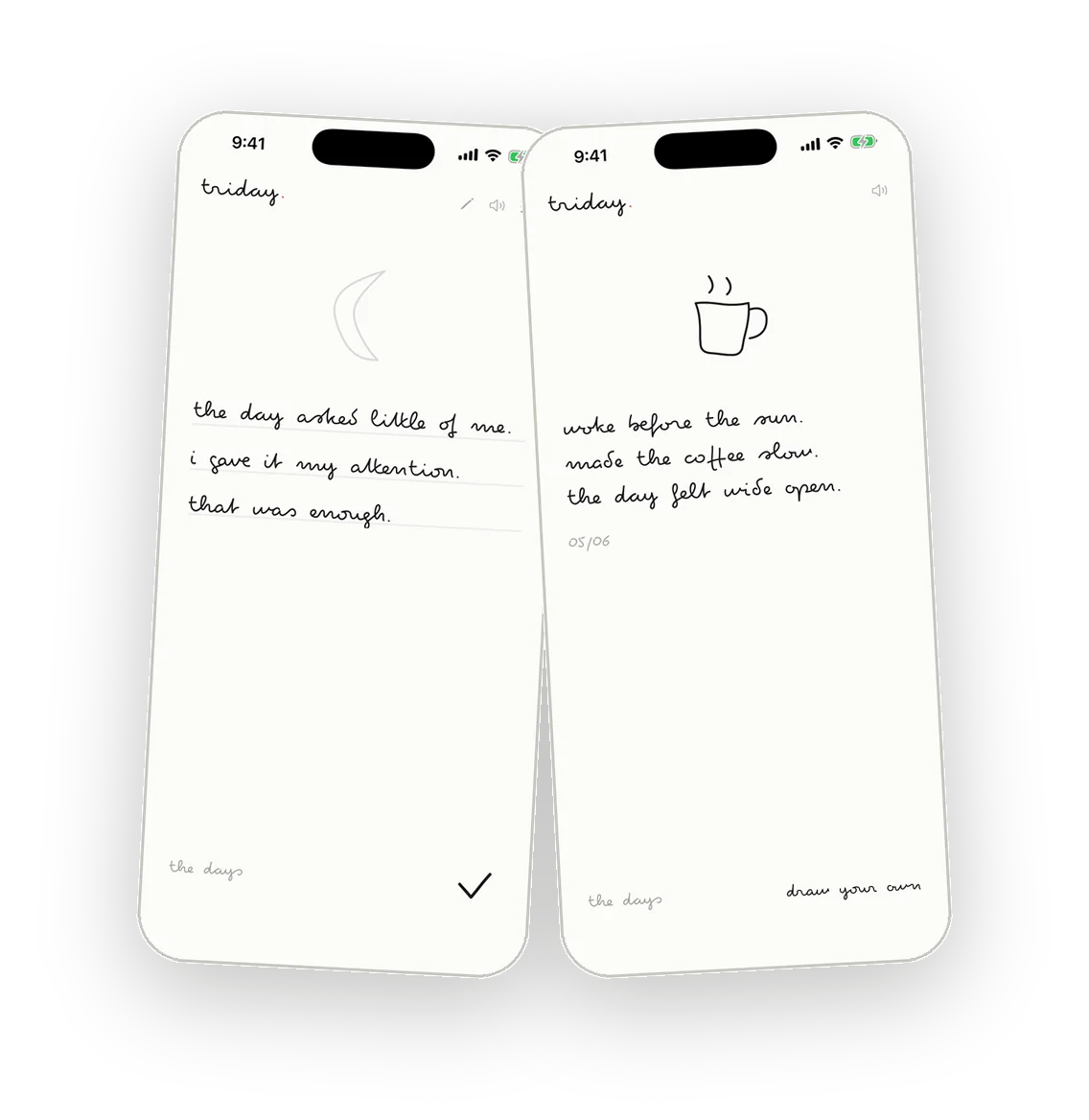
so how do you actually start one, tonight, without turning it into another evening chore you will abandon by march? you make it smaller than seneca did. he ran the whole day through his head, every word and act. you do not have to. the smallest honest version of his review is three written lines.
this is, quietly, the whole argument. the evening review is not a forty-minute ritual or a leather notebook you must fill. it is the habit of going back over your day, on purpose, before you sleep, and then stopping. write the three things that were today: one you did badly, one you did well, one you would change. or simply the three things that, read back in a year, would set you down again in exactly this day. three lines force a choice, and choosing is already the act of attention seneca was after. it is the difference between a diary that records the day and a practice that questions it, done in under a minute, then closed, so the sleep that follows is the deep kind.
before sleep, go back over today once, gently, the way a fair judge would, and write three short lines. what did i do badly? name it once, without the flinch. what did i do well? credit the day honestly; this is the line the stoics kept and most people drop. what could be better tomorrow? one small correction, set down lightly. then close it. that is seneca's review, made small enough to keep.
when the house goes quiet
two thousand years is a long time for a habit to survive on its own merits, with no institution required to keep it alive, no priesthood, no app, no streak. it survived because it is true to something. a day is not nothing. it is worth one honest look before you let it go. seneca knew that the look did not need to be long; it needed to be regular, and kind, and finished in time for sleep.
the practice is waiting for you in exactly the place it always was, the quiet after the lamp is out, the few minutes between the last task and sleep. you do not need to retrace every word the way he did. three lines will hold the day. write them, close the notebook, and let the years stop sliding past unread, which is, in the end, the only thing the man in the dark was ever really doing.
- Seneca describes his nightly self-examination, going back over everything he did and said each day before sleep, and credits the practice to Quintus Sextius, founder of the School of the Sextii, in On Anger (De Ira) 3.36. Sextius's questions and Seneca's own account ("totum diem meum scrutor factaque ac dicta mea remetior", I examine my whole day and measure again my deeds and words) are in the Latin text; faciebat hoc Sextius introduces the borrowing. Trans. John W. Basore, Loeb Classical Library 214 (Harvard University Press, 1928). ↗
- The evening self-examination in the Pythagorean Golden Verses, lines 40–44, "never suffer sleep to close thy eyelids" until you have gone back over the day and asked "wherein have I done amiss? what have I done? what have I omitted that I ought to have done?" Pierre Hadot traces the nightly examination of conscience from these verses through Seneca; see Philosophy as a Way of Life (Blackwell, 1995), the chapter "Spiritual Exercises." ↗
- On the Meditations as a private notebook of Stoic self-instruction, almost certainly never intended for publication: Pierre Hadot, The Inner Citadel: The Meditations of Marcus Aurelius, trans. Michael Chase (Harvard University Press, 1998). The Greek title, Ta eis heauton, means simply "to himself." ↗
- Pierre Hadot, Philosophy as a Way of Life: Spiritual Exercises from Socrates to Foucault, ed. Arnold I. Davidson, trans. Michael Chase (Blackwell, 1995; orig. Exercices spirituels et philosophie antique, 1981). Hadot describes Stoic practices as "spiritual exercises", disciplines meant to transform one's way of seeing and being, not merely one's beliefs. ↗
- The Ignatian Daily Examen adapts a much older evening self-examination found among the ancient Pythagoreans and Stoics; the twice-daily (midday and evening) structure is Ignatius's own, while the evening review is the ancient part. The Jesuit tradition itself acknowledges the pre-Christian roots, see Dennis Hamm, SJ, "Rummaging for God: Praying Backwards Through Your Day" (America, 1994), and the lineage is documented in Hadot, Philosophy as a Way of Life (1995). ↗
questions
what is the stoic evening review?
it is a short, daily practice of mentally retracing your day at night and asking what you did badly, what you did well, and what you could do better, done honestly but generously, then finished so you can sleep. seneca describes his own version in On Anger 3.36, crediting his predecessor Quintus Sextius, and it traces back further still to the Pythagoreans.
what questions did seneca ask himself at night?
seneca went back over his whole day and measured everything he had done and said. the questions he inherited from Sextius were roughly: what fault did you cure today? what vice did you resist? in what way are you better? the tone is a fair judge's, not a punisher's, he forgives himself one fault while warning himself off the next.
is the examen the same as the stoic evening review?
nearly. Ignatius of Loyola's Daily Examen adapts the same ancient evening review, and the jesuit tradition openly credits the Pythagoreans and Stoics for the practice. two differences: the twice-daily structure is Ignatius's own addition (the evening half is the old part), and the examen faces god where the stoic review faces virtue. you can read more on the lineage in the science under seneca.
how do i start an evening reflection practice?
make it smaller than seneca did. instead of retracing every word and act, write three short lines before sleep: one thing you did badly, one you did well, one you would change tomorrow. keep it generous rather than punishing, do it in under a minute, then close the notebook. that is the smallest honest version of the review, and it is the version that actually lasts.
the journal of a small, quiet diary app. we cite primary sources and report effect sizes honestly, and we don't make medical claims. how we write & what we won't say →