the science under seneca: what three good things journaling really does
in 2005 a study asked people to write three good things each night for a week. they were happier six months later, mostly the ones who kept doing it. seneca was already doing a version of it, without the data.
in 2005 a group of researchers ran a quiet little experiment over the internet, the one that sits, now, under every mention of three good things journaling. people signed up, and one of the things some of them were asked to do was this: every night for one week, write down three things that went well that day, and next to each, why it went well. that was the whole instruction. three good things and their causes, once a night, for seven nights. then the researchers checked back in, at one month, at three, at six, to see what, if anything, had changed.
what they found is the reason you have heard of the exercise at all. compared with where they started, the people who wrote their three good things each night were happier and less depressed, and the difference was still measurable six months later.1 a week of writing, three lines a night, and a mood that sat higher half a year on. it is one of the most cited results in positive psychology, and it is the science directly under the practice this whole essay is about.
but the headline hides the most important sentence in the study, and that sentence is the one worth keeping. so let us take it slowly: what the exercise is, what the data actually showed, where it is softer than it sounds, and why a roman who never saw the inside of a lab was already doing a version of it two thousand years ago.
what the three good things exercise actually is
it is almost embarrassingly simple, which is the point. at the end of the day you write three things that went well, and for each one you write a short cause, why it happened, or what it meant, or what part you played in it. that is all. in the original study it ran for a single week; in practice people do it for as long as it stays light enough to do.
the cause is not decoration. listing "good coffee, good call, good walk" is a quicker thing than asking, even briefly, why the call went well (because, say, you let the silence sit instead of rushing to fill it). the first is a record. the second makes you go back into the day and look at it. that small act of looking is most of the machinery, and we'll come to why.
note what it is not. it is not gratitude journaling, quite, though the two are cousins and get muddled constantly. gratitude can point at anything you're thankful for, including things you had no hand in, the weather, an inheritance, being born when you were. three good things leans toward the day you actually lived and, often, the part you played in it. that distinction matters more than it looks, and it has its own quiet argument; the broader question of whether gratitude journaling actually works we have taken up on its own page, so this one can stay narrow.
what the 2005 study really found
here is the study with its proper name on it, because precision is the whole brand. Seligman, Steen, Park and Peterson, "positive psychology progress," American Psychologist, 2005.1 it was randomized and placebo-controlled, the control group wrote about an early memory each night, and run online with a few hundred people. the three-good-things group, after their week, were happier and less depressed than at baseline, and the effect did not fade at one month. it was still there at three. still there at six.
that is genuinely a strong result for so small an ask, and it deserves to be said plainly before we complicate it. a free, one-minute habit, kept for a week, that shows up in someone's mood half a year later, that is not nothing. most things you try in a week leave no trace by june.
and now the sentence the headlines drop. the authors looked at who still had the benefit at six months, and the durable gains were largely concentrated among the people who had kept doing the exercise on their own, past the assigned week, without being told to.1 the one-week dose did not, by itself, buy six months of better mood. the people who were still better off in the summer were, mostly, the people who were still writing. the practice worked the way a practice works, by being a practice.
a week of it lifted people for six months. mostly the people who never really stopped.
this is not a flaw in the finding. it is the finding. and it happens to be the most useful thing the study can tell you, because it answers the question everyone actually asks, how long do i have to do this?, with the honest answer: not long to feel something, and indefinitely to keep it. which is only what is true of almost everything good. the gym does not bank you a year of strength for one good week.
why writing three of them does anything at all
so why would so slight a thing move anything? two parts, and we'll keep both honest.
the first is attention. a day is mostly forgotten by the time you brush your teeth, and what survives, untended, skews toward what went wrong, the curt email, the thing you forgot, the small failure. the brain is built to flag threats, not to file the afternoon light. asking for three good things, on purpose, with their causes, drags your attention back across the day and makes it stop on the things it would otherwise let slide. you are not inventing good days. you are noticing the ones you were already having. choosing three is itself the act: you can't list all of a tuesday in three lines, so you have to decide what the tuesday was, and deciding is already a small act of meaning.
the second part is gentler, and we'll hedge it on purpose, because the science here is suggestive rather than settled. putting an experience into words seems to do something to how it sits in you. in one fMRI study, the simple act of labeling a feeling in words was associated with lower activity in the amygdala, the brain's alarm, and more in a region tied to regulating it.2 that study was about naming emotions in faces, not about writing three good things at night, so it would be a real overreach to say it explains the exercise. it does not. but it sits alongside a longer line of work, going back to Pennebaker in the 1980s, finding that writing about your experience is linked to modest benefits for mood and even health.3 the careful word is linked. not rewires. naming a thing, including a good thing, and setting it down on the page appears to change your relationship to it a little. a little is the honest size of it.
where the evidence is softer than the headline
the honest version owes you the caveats, because they are the part the journaling industry quietly files away. they don't sink the practice. they right-size it.
the 2005 sample was self-selected, people who found a positive-psychology website and signed up hoping to be made happier, which is not a neutral starting line.1 the outcomes were self-reported. and three good things is not a clinical treatment for depression; it is a small mood intervention tested in a general population, and it should never be sold as a substitute for care when care is what's needed. later attempts to replicate this family of exercises have been more mixed than the famous result implies, sometimes the effect is there, sometimes it is faint against an active comparison. the honest summary is that the effect is real and modest, not large and guaranteed.
say it flatly, then, the way a friend would: the effect is small. it is also real. and small-and-real, kept up, turns out to be enough. that is the whole honest claim, and it is a better one than the inflated version, because it survives contact with your own life. you will not feel rewired tonight. you may, over weeks, find the day a touch easier to find at the end of it. that is the size of the thing, and it is worth having.
if your evenings are heavier than a hard day, if the bad outweighs the good most nights, for weeks, three good things is not the tool, and you deserve a person, not a notebook. the practice is for ordinary weather, not for the storm.
seneca got there first, without the data
now reach back. long before American Psychologist, before the word "psychology" existed, a roman closed his days like this. in On Anger, Seneca describes his nightly habit: when the light was out and the house had gone quiet, he went back over the whole day, everything he had done and said, and weighed it. he did not invent the practice; he says he took it from a teacher named Quintus Sextius.4 the questions he asked himself were close to the ones the modern exercise asks, only pointed at character: what did i do well today? where was i better? what do i still need to mend?
it is the same gesture, two thousand years apart. go back across the day, on purpose, and decide what it actually contained. Seneca was reaching, without a control group, for exactly the thing the 2005 study would later measure, that the day, reviewed deliberately at its close, returns something the unreviewed day does not. he had no effect sizes and no follow-up at six months. he had a quiet room and a habit, and the habit outlasted his century. if you want the fuller story of that nightly review and the three real questions under it, it has its own essay here.
what the science adds to Seneca is not permission, he didn't need it, but calibration. it tells us the effect is modest, that it lives in the keeping-up and not the one good week, that it is a small lift and not a cure. Seneca would not have been surprised by any of that. the stoics were never promising transformation by friday. they were describing a practice you do every night because you are the kind of person who does it, and the doing is most of the good.
three lines, which is the practice itself
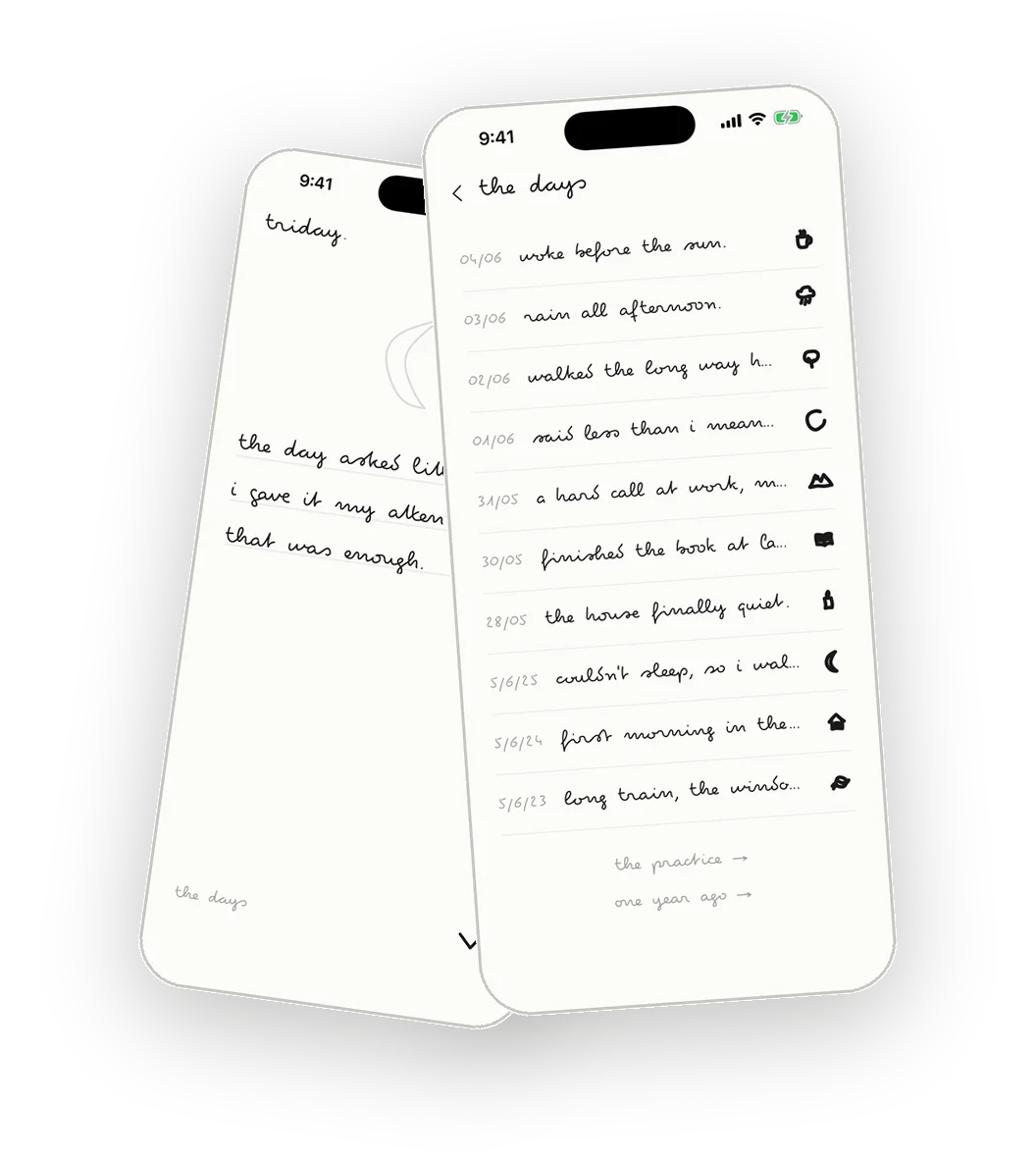
so here is where the science and the roman quietly agree, and where, just as quietly, this turns out to be a description of the only thing the app does. you don't need the cause written out as a paragraph. you don't need the full audit of the day Seneca gave himself. you need three lines and the minute it takes, the three things that were your day, chosen on purpose, set down, and then closed.
it is smaller than a diary and smaller than a journal, and that smallness is not a compromise. it is the part that makes it survive past the assigned week, which the 2005 study tells us is the part that actually matters. the people who were still better off in june were the people who never made it a project. they made it three lines. they kept it because it was light enough to keep.
write three things that went well today. for at least one of them, add a few words on why, what made it go well, or what part you had in it. then close the notebook. that is the exercise the study tested and the one Seneca kept; the only difference that matters is whether you're still doing it next month.
the headline of the science is that three good things made people happier for six months. the footnote, which is really the whole story, is that it did so for the ones who kept it up. so the practical takeaway is not a claim about your brain. it is a small, dull, true instruction: keep it small enough to keep. that is, more or less, the whole app, three lines a night, dated and closed, with nothing to perform and no streak to lose. the science is real and modest. the roman is real and old. and the part that works is the part you can do again tomorrow.
- Seligman, M. E. P., Steen, T. A., Park, N., & Peterson, C. (2005). Positive psychology progress: empirical validation of interventions. American Psychologist, 60(5), 410–421. In this randomized, placebo-controlled internet study, people who wrote three good things and their causes each night for one week were happier and less depressed than at baseline at the one-, three-, and six-month follow-ups, but the authors note the lasting gains were largely concentrated among participants who chose to keep doing the exercise on their own, beyond the assigned week. The sample was self-selected and outcomes were self-reported; treat the effect as real and modest, not clinical. ↗
- Lieberman, M. D., Eisenberger, N. I., Crockett, M. J., Tom, S. M., Pfeifer, J. H., & Way, B. M. (2007). Putting feelings into words: affect labeling disrupts amygdala activity in response to affective stimuli. Psychological Science, 18(5), 421–428. The study tested labeling emotions in images of faces, not expressive writing, so its application here is by extension, not proof; the defensible reading is that naming a feeling in words is associated with reduced amygdala activity and more right ventrolateral prefrontal activity, a possible neural correlate of why putting things into words may help. ↗
- On the longer expressive-writing tradition: Pennebaker, J. W., & Beall, S. K. (1986). Confronting a traumatic event: toward an understanding of inhibition and disease. Journal of Abnormal Psychology, 95(3), 274–281; with the meta-analytic picture in Frattaroli, J. (2006). Experimental disclosure and its moderators. Psychological Bulletin, 132(6), 823–865. Beginning with Pennebaker and Beall's small 1986 study, writing about one's experience has been linked to modest but consistently replicated benefits for mood and health, the average effect across roughly 146 studies is small (r ≈ .075), so "linked" and "modest" are the honest words, not "rewires." ↗
- Seneca the Younger, On Anger (De Ira) 3.36, in Moral Essays, Vol. I, trans. John W. Basore, Loeb Classical Library 214 (Harvard University Press, 1928). Seneca describes reviewing all his deeds and words each night before sleep, and credits the practice to the philosopher Quintus Sextius (founder of the School of the Sextii). Latin text freely available via the Perseus Digital Library. ↗
questions
does the three good things exercise actually work?
in the 2005 study that made it famous, yes, people who wrote three good things and their causes each night for a week were happier and less depressed up to six months later (Seligman et al., 2005). but the durable benefit was concentrated among those who kept doing it on their own, the sample was self-selected, and later replications are more mixed, so the honest size of the effect is small but real, not large or guaranteed.
how long do you have to do three good things?
long enough to feel something is short, the original study used just one week. but the six-month benefit lived mostly in the people who kept the habit going voluntarily, not in the one-week dose alone. so the real answer is that you keep it the way you keep any practice: indefinitely, because it is light enough to keep. a minute a night is the point.
what is the three good things exercise?
each night you write down three things that went well that day, and next to each, a short note on why it went well or what part you had in it. it differs from open-ended gratitude journaling by leaning toward the day you actually lived and the things you had a hand in. it is, give or take, the modern version of the stoic evening review Seneca kept two thousand years ago.
the journal of a small, quiet diary app. we cite primary sources and report effect sizes honestly, and we don't make medical claims. how we write & what we won't say →