does gratitude journaling actually work? the honest answer, with the caveats left in
yes, a little, and not the way the wellness blogs promise. the honest answer to whether gratitude journaling actually works, with the small print the overclaimers leave out.
you have been told to be grateful. someone gave you a notebook with the word printed on the cover, or an app pinged you at nine, or a wellness account told you that three things a night would change your life. and some evening, pen in hand, a small honest voice asked the question the cover did not answer: does this actually do anything, or am i just performing contentment to myself before bed? it can feel like homework. worse, it can feel like denial, sitting in a genuinely bad day, dutifully listing the sunset. so let's ask it plainly. does gratitude journaling actually work?
the honest answer, the one the overclaiming blogs cannot give you: yes, a little, and only if you do it in a way that stays true. the real evidence shows small, real gains in well-being, not a rewired brain, not a transformed life. it works best when it is specific, occasional, and honest enough to leave room for the day that was hard. forced, repetitive, or used to paper over a bad night, it does close to nothing, and can quietly curdle.
what the research actually shows
start where the science starts. in 2003, the psychologists Robert Emmons and Michael McCullough ran one of the first proper experiments on this: they had people briefly list, once a week, things they were grateful for, and compared them against people who listed hassles or neutral events.1 the gratitude group did come out ahead, they felt better about their lives as a whole, were more optimistic, even reported fewer physical complaints. that is a real result, and it is where most of the headlines you have read were born.
but read the paper itself and the hedge is right there in the authors' own words. the benefits showed up across several, though not all, of the measures they took. the most robust effect was on positive affect, on mood, on feeling good, not on the grand things the marketing implies. it is a genuine finding, carefully reported, and it is smaller and more specific than "gratitude changes your life." the people who first proved it were more honest about it than the people now selling it.
small, and real, and worth knowing about
one study is a beginning, not a verdict. so what happens when you gather all the studies together? this is where the honest answer gets its shape. the meta-analyses, the ones that pool dozens of gratitude trials and ask what is really there, find effects that are real but modest. Davis and colleagues in 2016, and Cregg and Cheavens in 2021, both land in roughly the same quiet place: gratitude practices nudge well-being and lower distress a little, and the gains shrink further when you compare gratitude not against doing nothing but against another active practice.2 the effect does not vanish. it just turns out to be the size of a real thing, not a miracle.
this is the sentence the wellness internet will not write, so here it is: no one wants to hear that the effect is small. but it is small, and real, and that turns out to be enough. a practice that reliably moves your evening a few degrees toward the good, for the price of one minute, is a good trade. you only feel cheated if someone first promised you the sun.
it does not rewire you. it tilts you, gently, a few degrees toward the good, and a few degrees, kept up, is most of what a habit can honestly offer.
the ways it goes dead, that no one admits
here is what the blogs leave out entirely, because it is bad for business: gratitude journaling has failure modes, and they are common. naming them is not cynicism. it is the difference between a practice that works and a ritual that quietly stops.
the first is the forced kind, gratitude as a thing you owe. told to be thankful on a day you are not, you produce the words without the feeling, and the gap between them teaches your nervous system that the exercise is a small lie you tell at bedtime. this is the legitimate grain of truth inside the "toxic positivity" objection. gratitude marshalled to deny a real feeling does not soothe it. it just adds a layer of guilt for not being grateful enough on top of whatever you were already carrying.
the second is repetition. the first week you write your family, your health, your home, and you mean it. by the third week you are copying yesterday's list, and the words have gone the way overused words go, smooth, weightless, dead. gratitude that is not specific is barely gratitude at all; it is a category you tick. the mind habituates to anything it sees nightly, and a stale blessing stops registering as a blessing.
the third is the most quietly harmful: gratitude used as a lid. you had a genuinely bad day, and instead of letting it be bad for the length of one honest sentence, you reach straight for the three good things to seal it over. the day does not get processed. it gets papered. and you learn, slowly, that the notebook is the place you go to pretend, which is precisely the place you will eventually stop going.
what actually makes it work
so it is not the word that works or fails. it is how you do it. the research and the failure modes point, together, at four small things that separate the gratitude practice that holds from the one that goes quiet by february.
- be specific. not "my family" for the fortieth time, the particular thing your sister said on the phone, the exact ten minutes the rain held off. specificity is what keeps the feeling attached to the words. a vague blessing is a dead one.
- say why. the most-tested version of this practice, three good things, each with its cause, asks you to trace the good moment back to its source, and that small act of tracing is where the click of meaning happens. naming the thing is not enough; you have to look at it.
- let it vary, and let it rest. forcing gratitude every single night can breed the very fatigue that flattens it. you do not have to perform thankfulness on schedule for it to count.
- leave room for the bad day. this is the one that saves the whole practice. three good things does not require pretending the day was good. "today was heavy" can sit at the top of the page, honestly, and the small true things can follow it without erasing it. gratitude that can hold a hard day alongside a good moment is the only kind that survives a real life.
this is, in fact, where gratitude journaling and the older, plainer habit it grew out of start to diverge, the nightly review the Stoics kept was never about counting blessings at all, but about telling the truth of the day. if you want the full lineage, that is its own essay.
three lines that are true, not three that are grateful
which is the quiet turn this whole question has been bending toward. the trouble with "gratitude journaling," as an instruction, is the word gratitude, it tells you in advance what the day was supposed to feel like, and then asks you to find evidence for it. that is the homework feeling. that is the denial feeling. you are not recording your day; you are auditing it for a predetermined verdict.
the smaller, truer version drops the adjective. write the three things that were your day. they don't have to be grateful. they have to be true. some nights all three will be things you're thankful for, and the gratitude will be real precisely because you didn't force it. it just turned out to be what the day held. other nights one line will be the hard thing, named once and set down, and the page will be honest, and you will have closed the day instead of pretending it away. on the worst nights, three true lines are a kindness you can actually manage when "three grateful ones" would be a small cruelty.
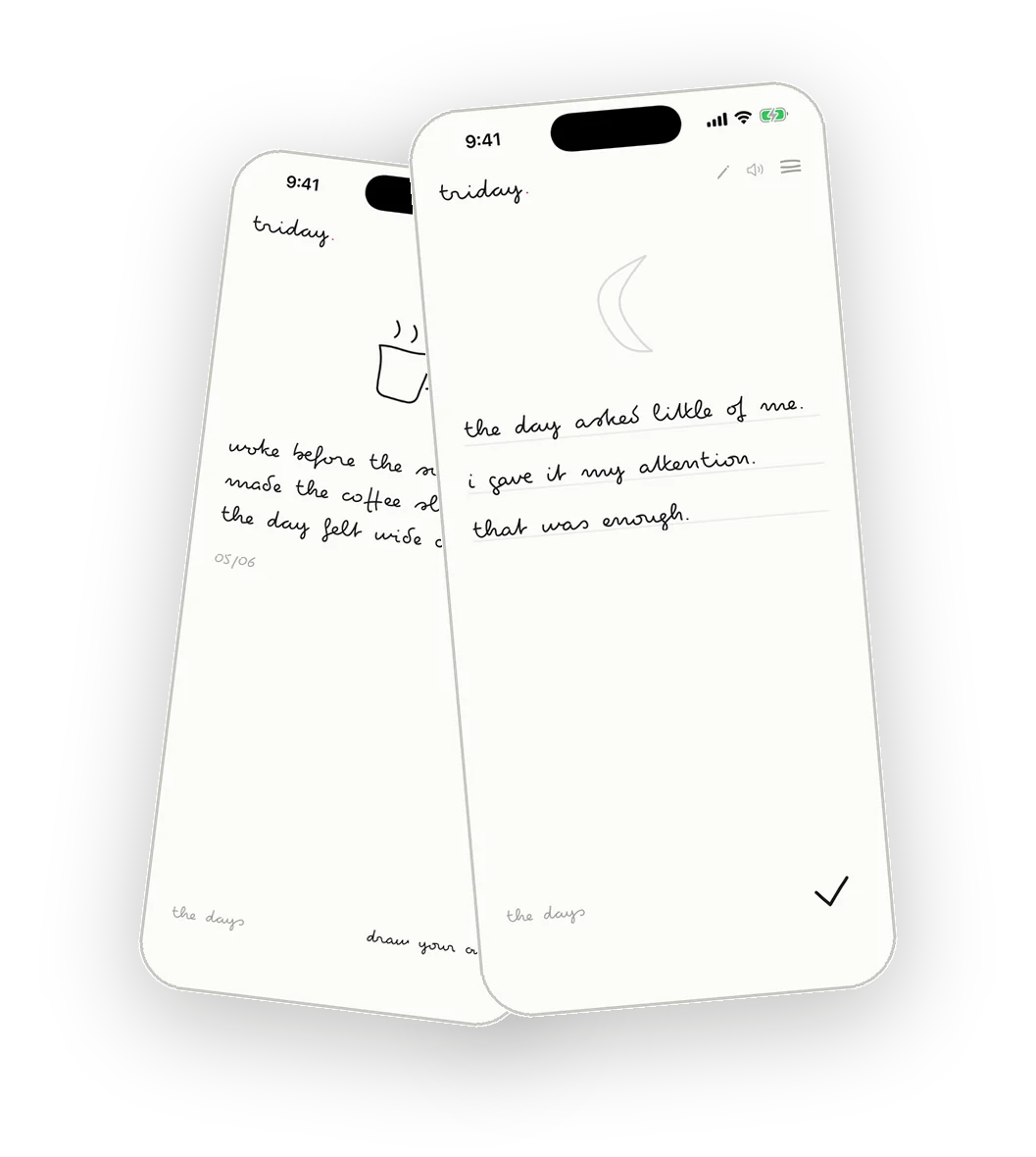
this is, more or less, the whole of what triday is: a place to write the three things that were today and then close it. not a gratitude prompt, not a mood you have to be in. just the day, in three honest lines, kept. if you've ever sat over an open notebook unsure what counts as gratitude, the answer is that it doesn't have to, it only has to be true.
write the three things that were today, not the three you ought to be grateful for, the three that were actually there. if one of them was hard, let it be hard; name it in a single sentence and don't argue with it. then look at the other two. if any genuine thankfulness is in them, it will be the kind you didn't have to manufacture. close the notebook either way.
so, does it work?
yes. honestly, modestly, and on conditions. gratitude journaling produces small, real gains in well-being, best evidenced for mood, smaller than the headlines, and easy to kill through force, repetition, or denial. it works when it is specific, when it asks why, when it is allowed to rest, and above all when it leaves the bad day room to be bad. strip the practice back to its honest core and you are left with something even plainer and even older than gratitude: a few true lines about your day, written down before sleep, so that the days stop sliding past unaccounted for. that is the part that always worked. the word on the cover was never the thing, the small, dated, honest account underneath it always was.
- On the early experimental evidence: Emmons, R. A., & McCullough, M. E. (2003). "Counting blessings versus burdens: An experimental investigation of gratitude and subjective well-being in daily life." Journal of Personality and Social Psychology, 84(2), 377–389. People who briefly listed things they were grateful for once a week reported greater well-being on several, though, by the authors' own account, not all, measures, with the most robust effect on positive affect. ↗
- On the pooled, meta-analytic picture, two reviews land in the same modest place. Davis, D. E., et al. (2016). "Thankful for the little things: A meta-analysis of gratitude interventions." Journal of Counseling Psychology, 63(1), 20–31 (doi:10.1037/cou0000107) found gratitude's gains on well-being can shrink to almost nothing when measured against another active practice rather than against no treatment. Cregg, D. R., & Cheavens, J. S. (2021). "Gratitude interventions: Effective self-help? A meta-analysis of the impact on symptoms of depression and anxiety." Journal of Happiness Studies, 22, 413–445, reported that effects on depression and anxiety are real but relatively modest. Both temper, rather than support, the dramatic claims of the wellness internet. ↗
questions
does gratitude journaling really work?
yes, but modestly. controlled studies (beginning with Emmons & McCullough, 2003) find small, real improvements in well-being, strongest for mood, and meta-analyses confirm the effect is genuine but not dramatic, and smaller still against an active comparison. it works best when it's specific and honest rather than forced. think a few degrees toward the good, not a transformed life.
how often should you write a gratitude journal?
less often than you'd think. writing forced gratitude every single night can breed a fatigue that flattens the effect; the mind habituates, and a thing you reach for occasionally tends to stay more alive than a nightly quota. the more sustainable habit is a short, true note about your day every night that doesn't have to be grateful at all, closer to three true lines than a nightly gratitude quota.
can gratitude journaling backfire?
it can. used to paper over a genuinely bad day, it becomes a small denial that leaves the feeling unprocessed, the legitimate grain of truth in the 'toxic positivity' objection. repeated mechanically, the same five blessings go dead. the fix is to let the day be honest: gratitude that can hold a hard day alongside a good moment is the only kind that lasts.
the journal of a small, quiet diary app. we cite primary sources and report effect sizes honestly, and we don't make medical claims. how we write & what we won't say →