a diary records your day. a journal questions it. there is a third thing.
a diary records what happened. a journal asks what it meant. and there is a third, smaller thing, older than both, that actually survives the year.
the two words get used as if they were the same. you keep a diary; you keep a journal; the shop sells both off the same table, in the same cloth covers, with the same little elastic band. but a journal and a diary are not one notebook with two names. they are two different habits of attention, and once you can feel the difference, you can also see why one notebook in your drawer went quiet by february, and what to keep instead.
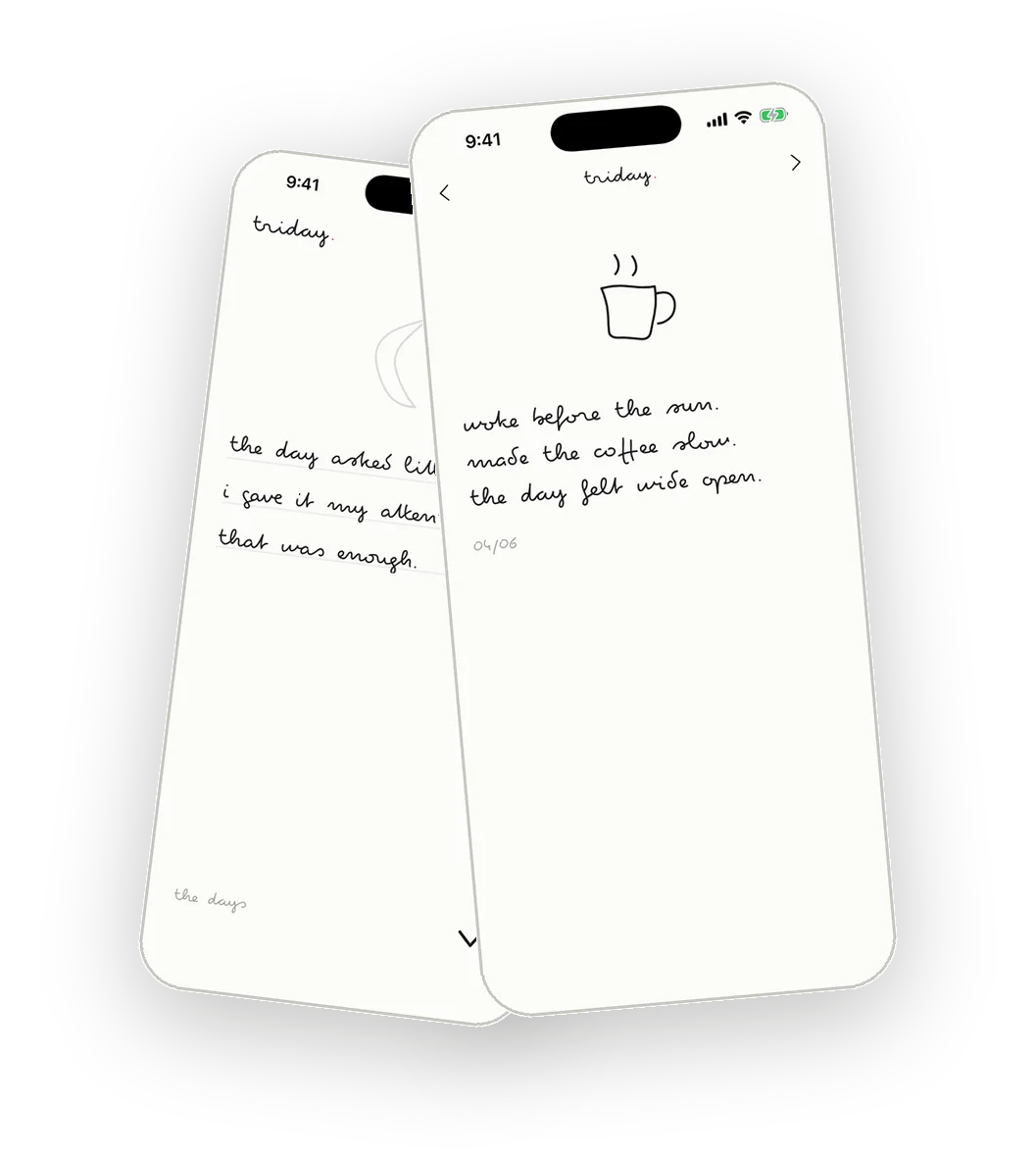
here is the difference, as plainly as it goes. a diary records what happened. a journal works out what it meant. a diary is dated and daily and outward: the train was late, it rained at four, she finally called. a journal is undated and inward and slow: why the call still sits in your chest a week later. one is a ledger. the other is a conversation you have with yourself, on paper, because some things only come clear in your own handwriting.
both words come from the day
they even start in the same place. "diary" comes from the Latin diarium, a daily allowance, a day's ration, from dies, the day. "journal" comes by a longer road, through the French jour and the Latin diurnalis, also the day, but it passes through the counting-house on the way: a journal was first a merchant's daybook, a ship's log, the place you entered the day's business before you carried it into the great ledger.1 so the split was there from the beginning. a diary keeps the day. a journal accounts for it. the question was never really day versus day. it was: what do you do with a day once you've got it down?
the diary's gift, and its limit
a diary is honest in the way a photograph is honest. it does not editorialise. it says: this is what the day contained, and here is the date to prove it. kept for years, a diary becomes the only reliable witness you have against your own memory, which is a generous liar. you think you remember the summer you were nineteen. you remember three scenes and a feeling. the diary remembers the tuesdays.
but a ledger of events has a failure mode, and anyone who has tried to keep one knows it. read back a week of pure record ("gym. lunch with R. emails. early night.") and it can tell you exactly what happened and almost nothing about your life. the days are all there and the year is missing. a diary can preserve a day so faithfully that it forgets to notice it.
the journal's gift, and its trap
the journal goes the other way. it doesn't want the record; it wants the meaning. it is where you think with a pen, where the half-formed thing gets dragged into the light and turned over until you understand it. people who journal well will tell you, rightly, that it is one of the cheapest forms of clarity there is.
the trap is the open page. a journal that asks how do you feel? and then waits, blank, is not always a help. for some of us, on some nights, the open inward page is just a well to fall down, the same worry, written longer, dressed as insight. the honest version is this: pouring it all out can clarify, and it can also deepen the groove you were already stuck in. the empty journal is a powerful tool and an unsupervised one. it does not know when to tell you to stop.
a diary remembers your days for you. a journal interrogates them. there is a third thing, smaller than both, that almost no one names.
the third thing
between the full record and the open interrogation there is a smaller habit, and it is older than the cloth-covered notebook by a couple of thousand years. it is this: at the end of the day, write the three things that were your day. not everything that happened. not a feeling traced to its root. three short lines, chosen on purpose, dated, and then closed.
it borrows the diary's discipline (dated, daily, done in under a minute) and the journal's attention, because three lines force a choice, and choosing is already a small act of meaning. you cannot write down all of a tuesday in three lines, so you have to decide what the tuesday was. that decision is the whole exercise. it is enough to find the day, and not enough to drown in it.
if that sounds too slight to matter, consider the most famous "journal" in history. Marcus Aurelius's Meditations is not a diary of his reign and not a long introspection. it is a private notebook of short reminders, repetitive, addressed to no one, almost certainly never meant to be read by another person.2 its Greek title just means to himself. the emperor of the known world kept the third thing: a few lines a night, to stay honest. it is closer to three lines than to morning pages, and it has outlasted every diary of its century.
so which should you keep?
not a trick question, and the answer is practical:
- want a record to read back in ten years? lean diary. concrete, dated, outward. you will be grateful to your past self for the boring entries most of all.
- working through something specific, a decision, a grief, a knot? lean journal. give it the long open page. (and if the knot is tight, a journal is not a substitute for a person to talk to.)
- started and quit a dozen notebooks? keep the third thing. three lines a night. the reason your diaries and journals died was almost never the format. it was the size of the ask.
that last point is the one the whole industry gets wrong, and it is worth saying flatly: a blank page the size of the sky is not a generous gift to a tired person at 11pm. it is the reason the notebook ends up in the drawer. the habit that survives is the one small enough to do on your worst night, and a diary you actually keep beats a beautiful journal you abandon every single time. (the other quiet killer is the streak counter, but that is its own argument.)
write the three things that were today. not the three most important things, not the three you're most grateful for, the three that, read back in a year, would set you down again in exactly this day. then close the notebook. that's the practice. if even that feels like too much, start with the version for when you don't know what to write.
the word was never the thing
so call it a diary if you like. call it a journal. keep arguing the definitions in the reviews of whichever app you download; people will, forever. the word was never the thing. the thing is three lines and the minute it takes to write them, kept up long enough that a year stops sliding past unread. that is the habit underneath both nouns, and it is the one worth keeping, a small, dated, honest account of the days, so that a year from now there is something there to find.
- On the shared root in day: "diary" is from the Latin diarium ("daily allowance," from dies, day); "journal" travels through Old French jurnal and Late Latin diurnalis ("daily"). Both go back to the day; they split in what you do with it. ↗
- On the Meditations as a private notebook of self-instruction, almost certainly never intended for publication: Pierre Hadot, The Inner Citadel: The Meditations of Marcus Aurelius (Harvard University Press, 1998). The Greek title, Ta eis heauton, means simply "to himself." ↗
questions
is a diary the same as a journal?
not quite. the words overlap, and most people use them interchangeably, but they point at two different habits. a diary is a dated record of what happened. a journal is an undated space for working out what things mean. one preserves the day; the other interrogates it.
which is better, a journal or a diary?
neither is better; they do different jobs. keep a diary if you want a record to read back in ten years. keep a journal if you are working through something specific. and if you have started and quit both, keep the smaller thing: a few lines about your day, every night. the format almost never kills the habit. the size of the ask does.
what do you call writing a few lines about your day?
there is no settled word for it, "line-a-day" and "micro-journaling" come closest. it is the oldest form of the habit: short, dated, done in under a minute. we call it the three-line method, and it is what most people should start with.
did Marcus Aurelius keep a diary or a journal?
closer to neither, and closer to the third thing. his Meditations was a private notebook of short reminders to himself, repetitive, addressed to no one, almost certainly never meant to be read. not a record of his days and not a long introspection, but brief notes meant to keep him honest. more on that here.
the journal of a small, quiet diary app. we cite primary sources and report effect sizes honestly, and we don't make medical claims. how we write & what we won't say →