morning vs evening journaling: what the evidence actually says about the best time to write
is it better to write in the morning or at night? almost every page dodges the question. here is the honest answer, with the studies most of them leave out.
search "morning vs evening journaling" and you get a hundred pages that all end the same way: it depends on you. they run two thousand words to avoid answering the question, and none of them cite a single study. so here is the answer they will not give you, with the research they leave out.
there is almost no evidence that the time of day itself changes what journaling does for you. the reflective and expressive-writing studies people cite never specified a clock. morning suits planning and a clear pre-day mind; evening suits reflection and winding down. but the honest verdict is that the best time is the one you will actually keep, and almost everything else is preference dressed up as science.
what the science actually says about timing
the benefits people attribute to morning or evening writing, less stress, a steadier mood, a clearer head, mostly trace back to one body of work: James Pennebaker's research on expressive writing. across decades of studies, writing about your thoughts and feelings for fifteen or twenty minutes, over a few sessions, is associated with modest but real improvements in wellbeing.1 here is the part the timing debate ignores: none of that research specified a time of day. participants wrote when the study told them to. the benefit was in the writing, not the clock.
there is exactly one well-known finding that is about timing, and it is worth getting right because everyone overstates it. in a 2018 sleep-lab study, fifty-seven adults spent five minutes writing before bed; those who wrote a to-do list for the next day fell asleep about nine minutes faster than those who wrote about tasks already done.2 that is a real, specific, useful result. but notice what it is: a to-do list, written to offload tomorrow's worries, not a reflective diary entry. it supports a particular kind of evening writing for the particular purpose of falling asleep. it does not show that journaling about your day works better in the evening than the morning. the most-cited "evidence" for evening journaling is, on inspection, evidence for something else.
the case for morning
the strongest morning tradition is Julia Cameron's morning pages, from The Artist's Way: three pages of longhand, stream-of-consciousness writing, done first thing on waking, before the news and the email and the day's noise arrive.3 the case for it is genuine and does not need a study to be plausible. a mind is often less cluttered before the day's inputs land. brain-dumping first thing can clear the head and surface what is actually on your mind, and writing your intentions before the day begins can set a direction the day then bends toward.
and morning has one structural advantage an honest evening partisan has to concede: it happens before the day can derail it. an evening practice competes with exhaustion, with the second drink, with the night you got home at one in the morning. a morning practice competes only with the snooze button. for a true night owl, or anyone whose evenings are reliably chaos, morning is simply the more defensible bet, because it is the one that will still be happening in a month.
the best time to journal is not in the science. it is in your calendar.
the case for evening
the evening tradition is older. it is the stoic review of the day, the practice Seneca described of going back over everything he had done and said before sleep, and it points at a different goal than the morning brain-dump. morning writing is mostly forward, planning, intention, clearing space. evening writing is backward: it asks what the day actually was, and lets you account for it before you let it go. if what you want from a diary is to notice your life rather than organise your day, the close of the day is the natural time to do it, because the day is there to be reviewed. that practice, and where it came from, is its own essay.
evening has the sleep finding in its corner, with the caveat above, and one more modest point: writing on paper, or on a dim screen, as a wind-down ritual is a gentler way to end the night than scrolling a bright phone into the small hours. that is a real argument for a calm evening habit. it is not a claim that journaling cures insomnia, and anyone who tells you it does is selling something.
so, morning or evening?
here is the verdict the dodging pages will not commit to. the clock matters far less than whether you keep showing up. the research that makes journaling worth doing is about the accumulation of the practice, and habit research is blunt about what builds that: not the perfect time of day, but consistency, anchored to a cue you already have.4 a habit takes a median of about two months to feel automatic, and, tellingly, missing a single day barely affects it. so the question is not "which time is optimal." it is "which time will still be happening next year."
so attach your writing to something you already do without fail. if your mornings have a quiet coffee, write then. if your nights have a moment after the light goes out, write then. and if you are genuinely unsure, the tie-breaker is simple: pick the time you are least likely to skip. the optimal time of day for a habit you have abandoned is no time at all.
do not optimise the hour. pick the more reliable one, the coffee or the lamp, and write three short lines about the day, what it was or what you want it to be. then do it again at the same time tomorrow. the cue does the work; the clock is a detail. if you keep missing it, the answer is almost never "wrong time of day," it is the way most apps punish the miss.
where triday lands
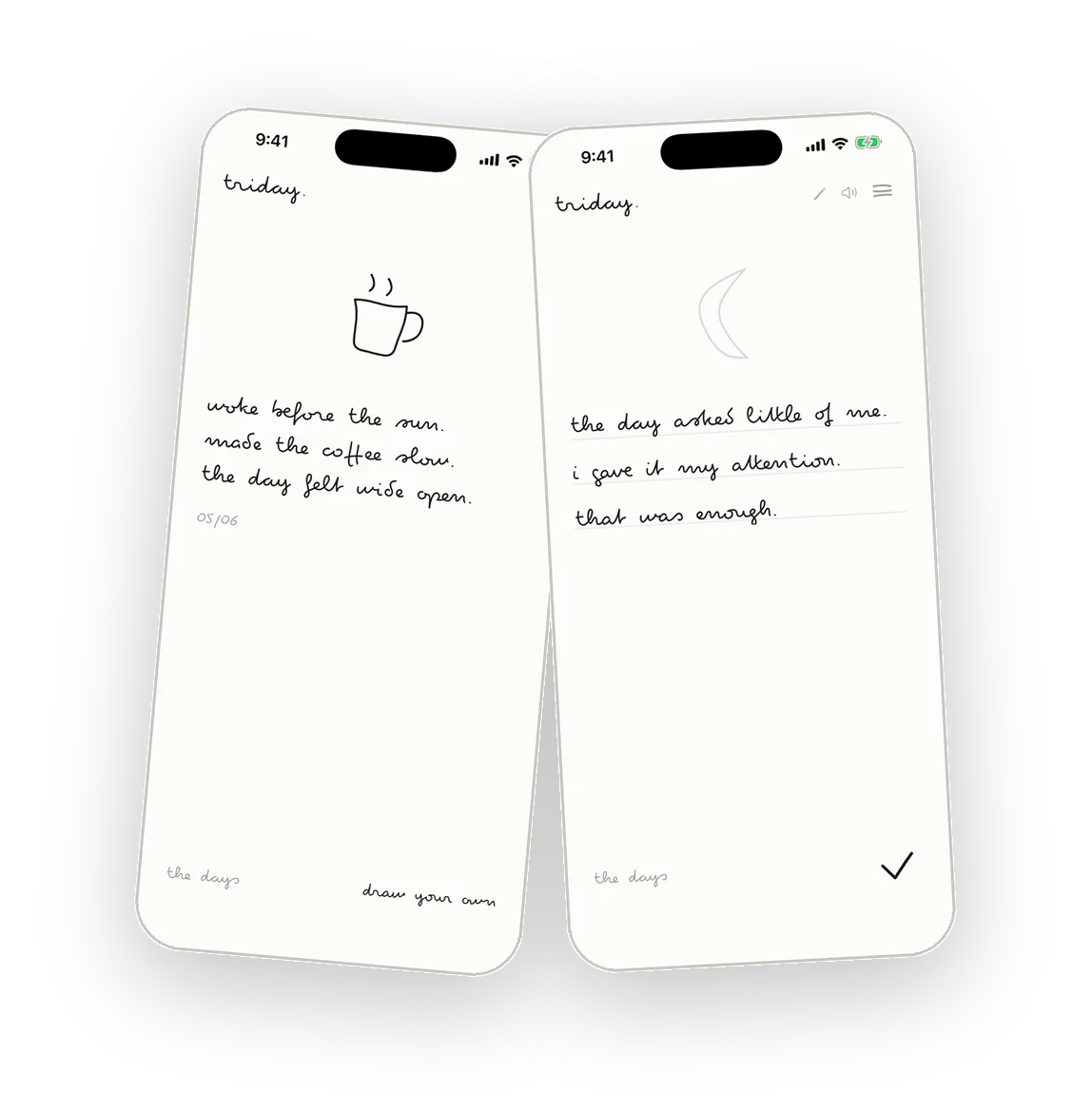
triday is built for the evening. it is the stoic close-of-day review, three lines about what the day was, and the design assumes you will reach for it as the day ends. but we will not pretend the morning has no case, because it plainly does, and a thirty-year-old practice and a clear-headed hour are nothing to wave away. so write triday in the evening if the evening is yours, and in the morning if the morning is. it does not keep a streak, so it does not care which you choose or which days you miss. it only cares that, at whatever hour is actually reliable for you, there are three honest lines about the day, kept up long enough that a year stops sliding past unread.
- On expressive writing's benefits, which are about the practice rather than the time of day: Baikie, K. A., & Wilhelm, K. (2005). Emotional and physical health benefits of expressive writing. Advances in Psychiatric Treatment, 11(5), 338-346, summarising James Pennebaker's paradigm (writing 15-20 minutes on several occasions; no time of day specified). ↗
- On the one time-bound finding: Scullin, M. K., Krueger, M. L., Ballard, H. K., Pruett, N., & Bliwise, D. L. (2018). The effects of bedtime writing on difficulty falling asleep. Journal of Experimental Psychology: General, 147(1), 139-146. 57 healthy adults; those who wrote a to-do list for five minutes before bed fell asleep faster than those who wrote about completed tasks. ↗
- On morning pages: Julia Cameron, The Artist's Way (1992), and her own description of the practice, three longhand pages on waking. ↗
- On consistency beating timing: Lally, P., van Jaarsveld, C. H. M., Potts, H. W. W., & Wardle, J. (2010). How are habits formed. European Journal of Social Psychology, 40(6), 998-1009. A new habit takes a median of about 66 days to feel automatic, and missing a single day did not materially affect the process. ↗
questions
is it better to journal in the morning or at night?
there is no strong evidence that the time of day itself changes the benefits. the reflective and expressive-writing research is about the practice, not the clock. morning suits planning and a clearer pre-day mind (Cameron's morning pages); evening suits reflection and wind-down (the stoic review). the one hard time-specific finding is that a brief to-do list before bed helped people fall asleep faster. pick the time you will actually keep.
does the science say journaling at a certain time of day works better?
mostly no. James Pennebaker's expressive-writing studies, which show real reductions in stress, never specified a time of day. the one genuinely time-bound result is a 2018 sleep-lab study, and it is narrow: writing a to-do list before bed sped sleep onset. that supports a kind of evening writing for sleep, but it is not evidence that reflective journaling works better in the evening.
what are morning pages?
morning pages are Julia Cameron's practice from The Artist's Way (1992): three pages of longhand, stream-of-consciousness writing done first thing on waking, before the day crowds in. the goal is not a polished record but a brain-dump that clears the head and surfaces what is actually on your mind.
does journaling before bed help you sleep?
there is evidence for one specific version. in a 2018 Baylor sleep-lab study, people who spent five minutes writing a to-do list before bed fell asleep faster than those who wrote about completed tasks, about nine minutes faster on average. note it was a to-do list, not reflective journaling. writing on paper also avoids the bright-screen-before-sleep problem, though that is a caution, not a cure.
the journal of a small, quiet diary app. we cite primary sources and report effect sizes honestly, and we don't make medical claims. how we write & what we won't say →