a journaling app with no AI
your diary is the most unguarded thing you write. more apps now run it through a model that reads and replies. here are the ones that still just let you write.
a few years ago "AI journaling" did not exist as a category. now it is half the App Store. you write a few sentences about your day and a model reads them and writes back: a follow-up question, an "insight," a gentle observation about your patterns. for some people that is the appeal. for a growing number, it is the exact reason they are looking for a way out, typing "journaling app no AI" into a search bar and finding mostly more AI.
so, plainly: which journaling apps don't use AI? the genuinely AI-free options are triday (none, by design) and Daylio (a mood tracker with no reflective AI). the apps built around an AI that reads your entries and answers are Rosebud, Reflectly, Stoic's AI tier, Day One's Gold tier, and Journey. the difference between those two groups is bigger than it looks.
which journaling apps use AI, and which don't
| app | AI in your diary | what it does |
|---|---|---|
| triday. | none | nothing reads, suggests, or replies |
| Daylio | none (reflective) | mood tracker; only OS writing assist |
| Diarly | optional add-on | an "AI Assistant" you can pay extra for |
| Day One | reads & replies | "Daily Chat" + insights (Gold tier) |
| Reflectly | reads & replies | AI prompts and mood insights |
| Stoic | reads & replies | AI journaling and AI "mentors" (AI tier) |
| Journey | reads & replies | "Odyssey" reads past entries and responds |
| Rosebud | reads & replies | built around an AI that answers you |
a spell-check is not a reader
not all "AI" is the same thing, and the honest version of this page has to say so. there is a real difference between a tool that helps you type and a tool that reads you. on-device writing suggestions, or a built-in proofreader, run on your phone and never form an opinion about your life. Rosebud reading your week and telling you what it noticed is a different category entirely: a second party, in the room, with a view. when people say they want a journal without AI, it is almost always the second kind they mean. the table above keeps them apart on purpose.
a diary is the one document you write precisely because no one is reading it.
why a diary is the worst place for AI
journaling is one of the few things you do where the absence of an audience is the entire point. there are three reasons a reader, even a synthetic one, works against it.
you write differently when something is reading. the moment you know your words will be parsed and answered, you start, quietly, to perform: to be a little more articulate, a little more resolved, a little less ugly than the day actually was. the unguarded sentence is the valuable one, and it is the first casualty of an audience.
the work is supposed to be yours. putting an experience into your own words is most of what journaling does; in the research, naming a feeling plainly is associated with taking some of its charge out. when a model offers the words, or the insight, you have skipped the one part that was doing the work. you get a tidier page and a less examined life.
it is your most private text. a diary holds the things you have told no one. an AI that reads it needs that text to leave your hands, to a model, usually in the cloud, under a privacy policy you did not read. for the single most sensitive document you keep, that is the last place the data should go. (if that is what worries you most, the on-device, no-account options are here.)
some people are helped by it, and pretending otherwise would be dishonest. if you sit down to write and freeze, an AI that asks a good next question can get you moving. if you are lonely with something, being "heard," even by a model, can take the edge off a hard night. Rosebud is genuinely the best of these, thoughtful and well-built, and we put triday and Rosebud side by side here. if a reflective partner is what you want, that is a real and reasonable choice. just go in knowing the trade: something is reading, and the words are partly its.
triday will not add it
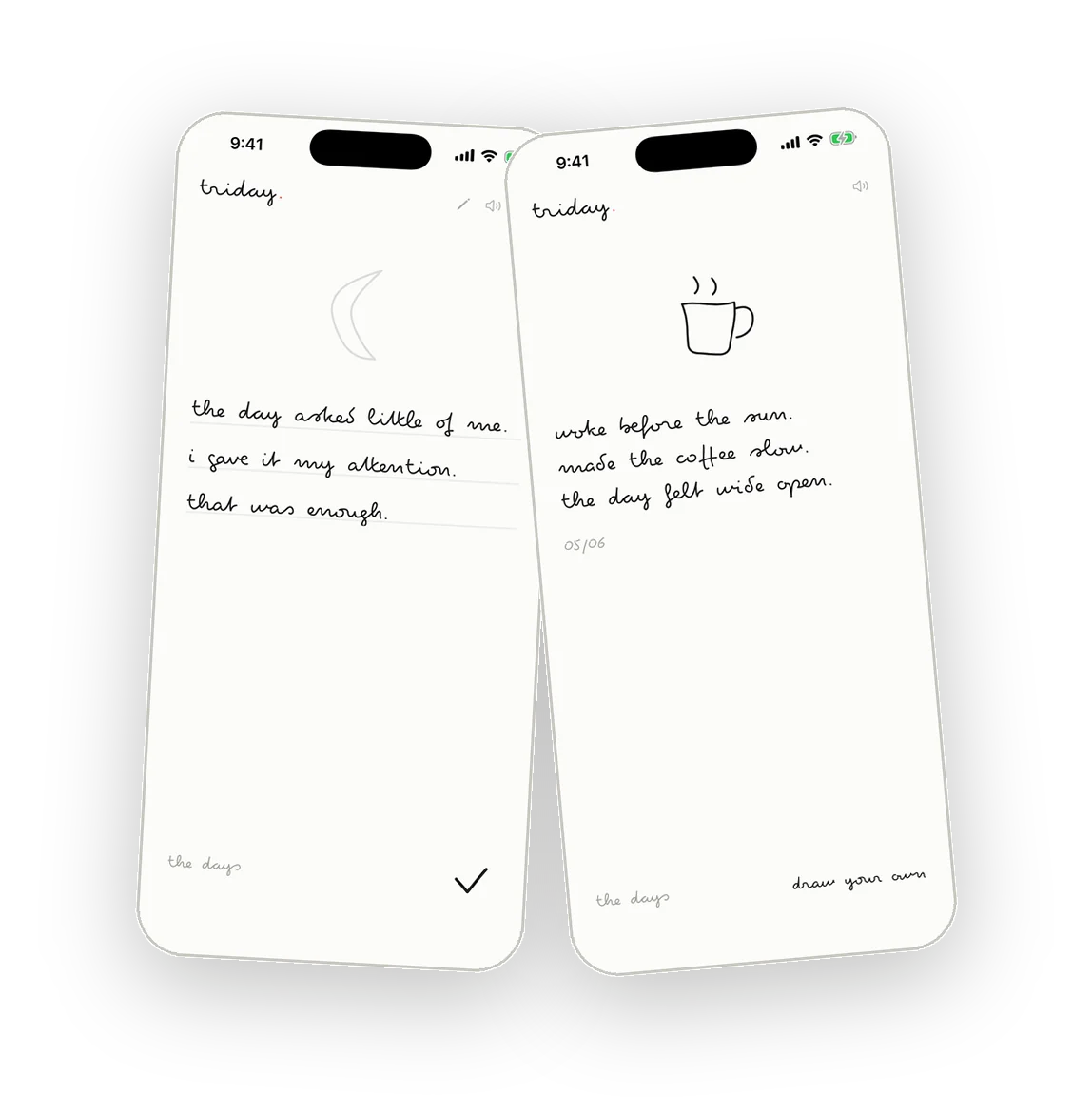
triday has no AI, and that is not a feature we are saving for a later version. it is a line. you write the three things that were your day, in your own words, and they sit on your device. nothing reads them, nothing suggests them, nothing writes back. the page stays what a diary has always been: a private room with no one else in it. that is also why it has no streak and no $60-a-year bill, fewer things between you and the day, not more.
questions
is there a journaling app that doesn't use AI?
yes. triday has no AI and will not add it. Daylio has no reflective AI either. the apps built around an AI that reads and replies to your entries are Rosebud, Reflectly, Stoic's AI tier, Day One's Gold tier, and Journey.
will triday ever add AI?
no. it is a line, not a feature we are saving for later. a diary is the one place you write precisely because nothing is reading, so triday stays a private room with no one else in it.
why would i not want AI in my journal?
knowing something is reading changes what you are willing to write, so you perform instead of being honest. the value of journaling is putting things in your own words, which an AI does for you. and your diary is the most private text you keep, so a model is the last place you want it going.
does triday use AI?
no, and it never will. triday is three plain lines about your day, written by you, stored on your device. nothing reads your entries, suggests them, or replies to them.
we keep an honest, dated comparison of the diary apps and separate real differences from marketing. how we write & what we won't say →