a journaling app without a subscription
most of them rent you monthly access to your own words at $40 to $108 a year. a few still let you pay once and keep it. here is the honest list, what a decade actually costs, and the cheapest way through it.
there is something quietly strange about paying a monthly fee to read your own diary. a streaming service rents you films somebody else made; a gym rents you equipment you could not keep at home. but a diary is not a thing you consume. it is a thing you make, a line at a time, and then keep, sometimes for the rest of your life. and most journaling apps now ask you to pay, every month, forever, for the privilege of keeping it.
so the honest question, if you are looking for a place to write and you have had enough of subscriptions: which journaling apps let you pay once? the short answer is that a handful do, and most do not. triday sells a one-time lifetime unlock alongside the smallest plan in the category, about $1.24 a month, billed $14.99 once a year, and its three-lines core is free either way. Journey and the Five Minute Journal sell a lifetime option alongside their monthly plans. Day One, Reflectly, Stoic, Rosebud and Diarly are subscription-only, and Daylio keeps a free tier with a subscription for extras. here is the full picture.
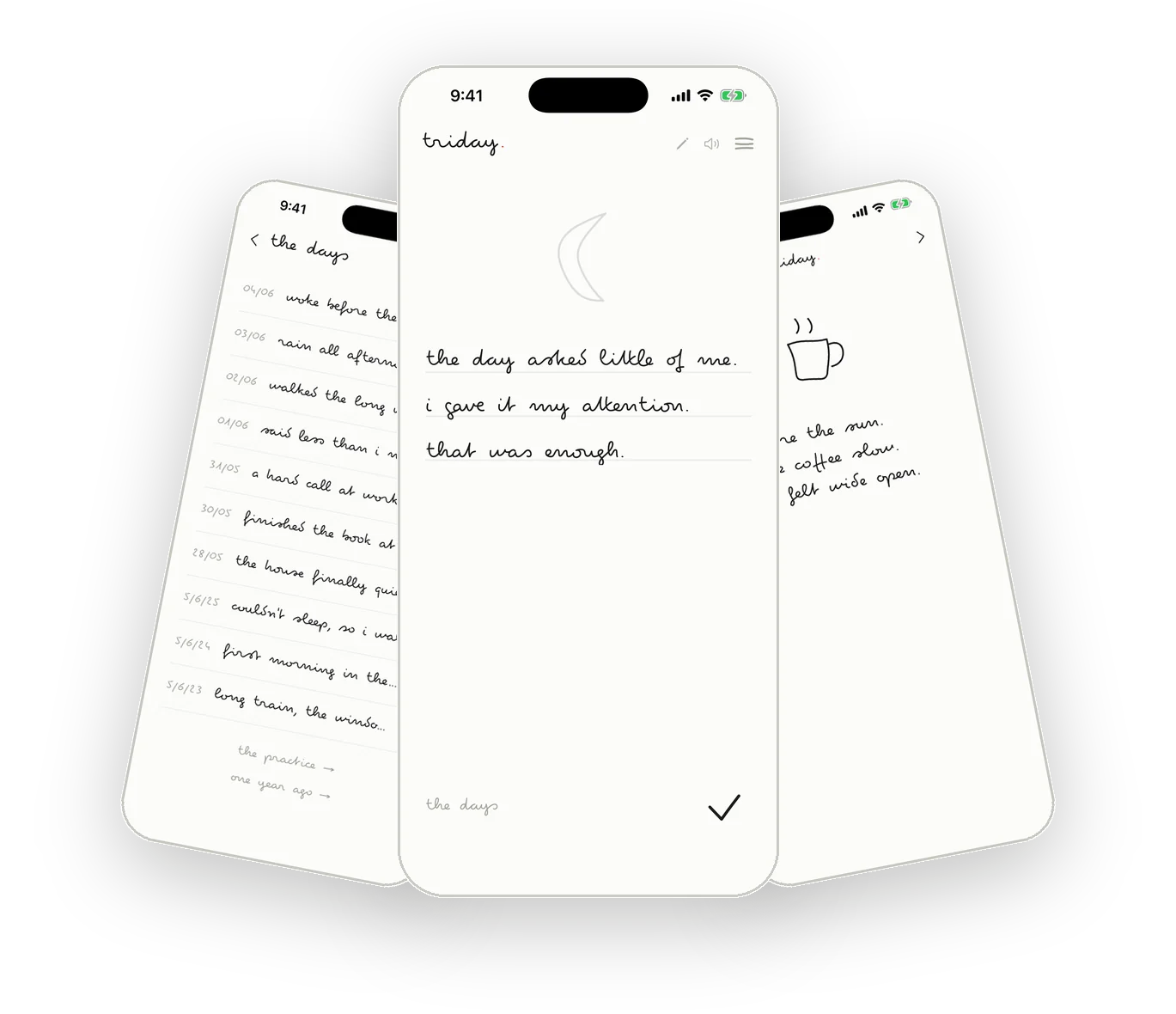
which journaling apps are subscription-only, and which aren't
| app | pricing | subscription (US) | pay-once option |
|---|---|---|---|
| triday. | free core + full unlock | $14.99/yr (~$1.24/mo) | yes, $49.99 once |
| Day One | free tier + sub | $49.99/yr (AI tier $74.99/yr) | no |
| Reflectly | subscription | $59.99/yr | no |
| Stoic | subscription | $39.99/yr (AI up to $99.99/yr) | no |
| Rosebud | subscription | $107.99/yr | no |
| Daylio | free tier + sub | $35.99/yr | no |
| Diarly | subscription | ~$19.99–25.99/yr | no |
| Journey | sub or lifetime | $49.99/yr | yes, lifetime $199 |
| Five Minute Journal | sub or lifetime | $39.99/yr | yes, lifetime |
two things stand out. first, the genuinely pay-once options are rare: triday's $49.99 lifetime, and the lifetime tiers of Journey ($199) and the Five Minute Journal. second, the subscriptions are not small, and the ones that lean on AI are the most expensive of all. triday's own plan, if you take that door instead, is $14.99 a year, about $1.24 a month, a third to a seventh of everything else on the list.
what a subscription actually costs over ten years
a subscription price looks harmless by the month. the honest way to read it is to remember how long you actually keep a diary. people return to journals they started a decade ago; that is the whole point of keeping one. so here is the same list, priced the way a diary is actually used, at today's annual rate held flat (it rarely is):
| app | per year | over 10 years |
|---|---|---|
| triday. | $14.99 (~$1.24/mo) | ~$150, or $49.99 once |
| Daylio | $35.99 | ~$360 |
| Stoic | $39.99 | ~$400 |
| Day One | $49.99 | ~$500 |
| Reflectly | $59.99 | ~$600 |
| Stoic + AI | $99.99 | ~$1,000 |
| Rosebud | $107.99 | ~$1,080 |
a thousand dollars to keep a diary is not a bargain anyone would accept if it were quoted up front. it only feels reasonable a few dollars at a time, which is exactly why the model exists.
for contrast: ten years of triday at today's price is about $150, less than half of anything else on the list, and day by day it works out to roughly four cents a day for a diary you write daily. and if you would rather never see a renewal at all, the lifetime unlock is $49.99, once: the same money as a single year of Day One, and it is the whole price, for good.
you can rent a film. you should not have to rent the record of your own life.
why a diary, especially, shouldn't be a rental
subscriptions make sense for things you consume continuously. you pay netflix this month for films you watch this month; stop paying and you have lost nothing you made. a diary is the opposite kind of object. its value is not this month's entry. its value is the slow accumulation, the thing you open in ten years to find the tuesday you had forgotten. that value lives in the keeping, and a subscription quietly puts the keeping on a meter.
and there is the uncomfortable question every subscriber should ask: what happens to my entries the month i stop paying? with most apps, your past writing stays readable but new entries or the features you relied on lock behind the paywall. your diary becomes a thing you can look at but no longer fully use unless you keep paying. for the one document you most want to still be able to open, untroubled, decades from now, that is the wrong arrangement. the safest place for a diary is an app whose core does not expire and whose words sit on your own device, where access never depends on a renewal going through.
this is not a case that subscriptions are a scam. they pay for real, ongoing work: cloud sync across your phone, tablet and laptop; storage for years of photos; active development; servers. if what you want is a media-rich, cross-device, continuously-improved archive, Day One's subscription buys exactly that, and it is the best in the category at it. the question is not whether the work is real. it is whether you need that much app, every month, for what is really three lines before bed.
triday's answer
triday was built for the person who answered "no" to that question. the core, the three things that were your day, is free, and it never expires. the full diary is about $1.24 a month, billed $14.99 once a year, the smallest bill in the category, and a single $49.99 unlock, once, is there for anyone who would rather own it outright. either way, your entries live on your device, sync through your own iCloud if you turn it on, and stay yours whether or not you ever pay another cent. nothing you have written can lock behind a lapse.
the deeper reason is the same one behind everything triday does without: a habit you can keep for decades should not have a meter on it. that is also why there is no streak counter and no AI reading your entries. less to pay for, less to perform, less between you and the page.
questions
is there a journaling app you only pay for once?
yes. triday sells a $49.99 lifetime unlock, once, alongside its $14.99-a-year plan (about $1.24 a month), and its three-lines core is free. Journey and the Five Minute Journal sell lifetime options alongside their monthly plans. most others, including Day One, Reflectly, Stoic, Rosebud and Diarly, are subscription-only.
why are journaling apps subscription-only now?
recurring revenue is simply worth more to a company than a one-time sale, and cloud sync and AI features carry ongoing server costs. that can be a fair trade for a media-rich, cross-device app. it is a worse fit for a small diary you mostly keep to yourself.
what happens to my entries if i stop paying?
it depends on the app. most keep your past entries readable but lock new ones or premium features behind the paywall when a subscription lapses. the safest position is an app whose core is free or paid-once and stores your writing on your own device, so access never depends on a renewal.
is triday free?
the core practice, three lines a day, is free, and your entries never lock. the full diary is about $1.24 a month, billed $14.99 once a year, the smallest price in the category, or a one-time $49.99 lifetime unlock if you would rather never see a renewal at all.
we keep an honest, dated comparison of the diary apps and report prices as we find them. how we write & what we won't say →