a minimalist journaling app, no streaks
open most journaling apps and count the things between you and the page: a streak, a mood wheel, a badge, a pet to keep alive. here are the ones that just let you write.
you sit down to write three lines about your day, and the app has other plans. there is a number in the corner counting your streak. a wheel of moods to tap first. a weekly graph filling in. a badge you almost earned. somewhere a little creature needs feeding. none of it is writing, and all of it is between you and the page. if what you actually want is to put down what the day was and close the app, most journaling software now asks you to run an obstacle course to do it.
so: which journaling app is genuinely minimalist, with no streaks? triday is the one built for exactly this, three lines on one screen, no streak, no gamification, nothing to maintain. Daylio is simple but still keeps streaks and stats. Reflectly and the Five Minute Journal gamify with streaks and habits, and Finch turns the entire app into a pet you keep alive by showing up. here is what each one bolts on top of the writing.
what each app adds on top of writing
| app | streak | gamification | mood charts / dashboard |
|---|---|---|---|
| triday. | none | none | none |
| Day One | streak | light | timeline, maps, on-this-day |
| Reflectly | streak | habits, affirmations | mood insights |
| Five Minute Journal | streak | light | progress |
| Daylio | streak | badges, goals | year in pixels, charts |
| Finch | streak | heavy (virtual pet) | collectibles, rewards |
not a streak to protect. only days you were here for.
why a streak is the wrong reward for reflection
the streak is the most common addition, and the most quietly harmful. it takes an intrinsic habit, writing because the day deserves a line, and bolts on a second, separate goal: do not break the chain. and the trouble with a chain is that it can only be lost. the night you are tired or away or simply human, the counter resets to zero and tells you that you have failed, on the exact night you most needed the small kindness of a habit that waits. the evidence is almost insulting in its clarity: missing a single day barely affects a habit at all. it is the reset, and the story it tells, that makes people quit. for a calm evening practice, the streak is not motivation. it is the thing most likely to end it. (the full case against streaks is here.)
what "minimalist" should actually mean
"minimalist" is a crowded word; half the apps in the table above use it in their own marketing. so here is a stricter test. a genuinely minimalist journaling app has no feed to scroll, no dashboard to interpret, no mood graph to feed, no streak to protect, and no second screen at all. you open it, you write what the day was, you close it, and the whole transaction takes less than a minute. the measure of a minimalist diary is not how clean the icons are. it is how little it asks of you on the night you have nothing left to give.
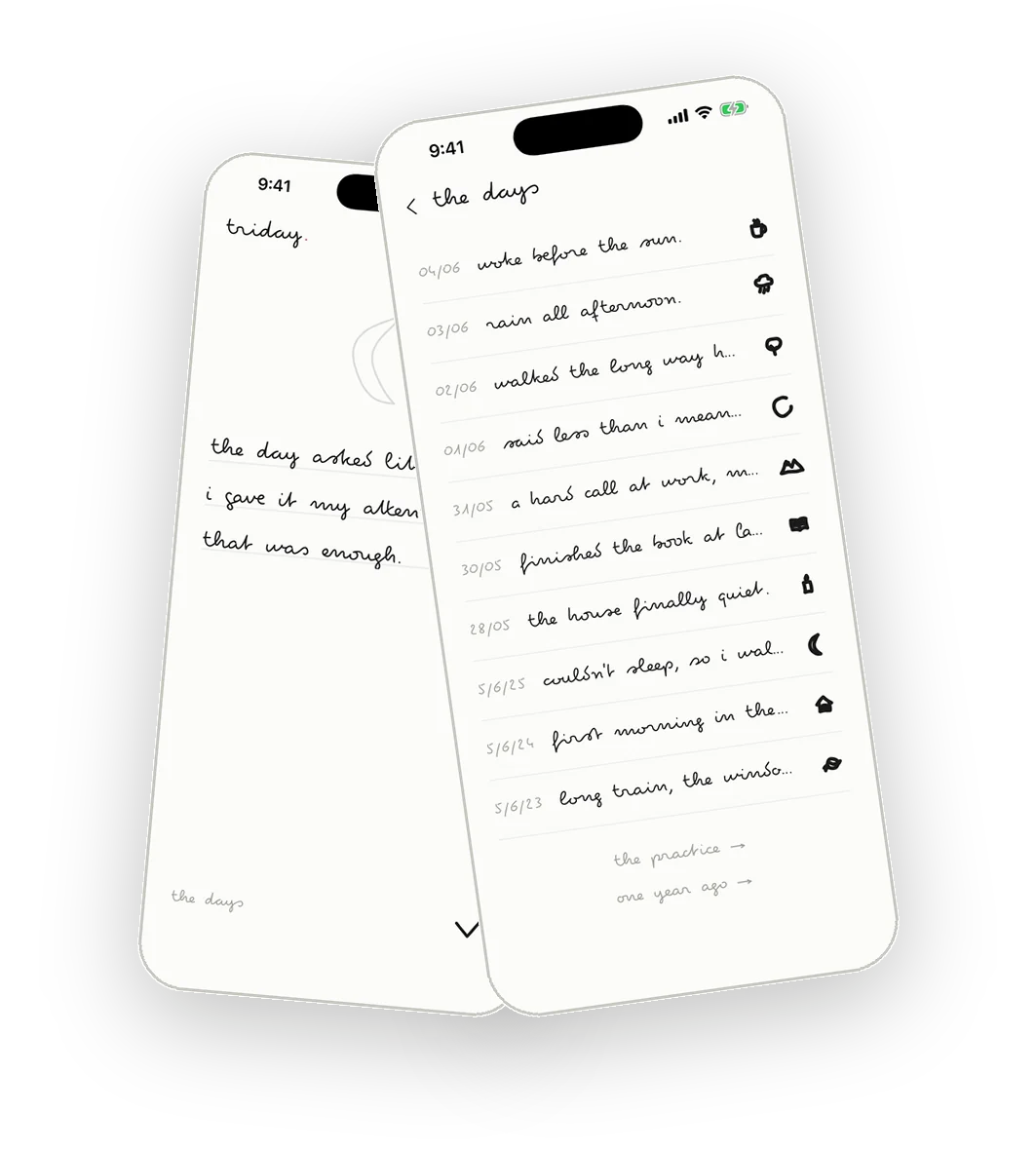
triday is built to pass that test. one screen. three lines. a quiet doodle when you keep the day, and nothing else: no number, no chart, no badge, no pet. the design goal was not "fewer features." it was "nothing between you and the day."
this is not a claim that streaks and rewards never help anyone. for pure habit-formation, they plainly do: Finch has helped a lot of people do their first self-care of the day, and Daylio's charts are a genuinely useful tool if what you want is to track moods and see patterns over months, a fork we lay out in full in triday vs Daylio. those are real jobs, done well. the argument here is narrower and, we think, true: for reflection specifically, writing honestly about your day, the counter and the dashboard distort the very thing they are trying to encourage. if you want a habit tracker or a mood log, those apps are good. if you want a diary, you want less.
triday's answer
triday has no streak, no badges, no rewards, no feed, no graph. its one quiet idea, "not a streak to protect, only days you were here for," is a refusal: the practice is the writing, and the writing survives precisely because there is no number on it you could lose. you can miss a night, or a week, and come back to find nothing punishing you and nothing reset. the gaps are part of the truth of a life, and a diary that can hold them is the only kind you keep for years. it costs about $1.24 a month, a fraction of what the category charges, and there is no AI in it either.
questions
is there a journaling app without streaks?
yes. triday has no streak counter and no gamification of any kind. most others add a streak: Reflectly, the Five Minute Journal and Daylio all track them, and Finch turns the whole app into a pet you keep alive with daily use.
why are streaks bad for journaling?
a streak turns an intrinsic habit into a number you keep to avoid losing. the night you miss, it resets to zero and tells you that you have failed, which is exactly when most people quit, even though missing one day barely affects a habit at all. for a quiet evening practice, the counter is the thing that ends it.
what is the most minimalist journaling app?
triday is built to be the smallest version of the practice: three lines on a single screen, no feed, no dashboard, no mood graph, no streak, done in under a minute. Daylio is simple but still adds streaks and stats; the rest add more.
does triday have streaks?
no. triday deliberately has no streak counter, no badges, and no rewards. its philosophy is "not a streak to protect, only days you were here for." miss a night and nothing resets or punishes you.
we keep an honest, dated comparison of the diary apps and say plainly what each one adds. how we write & what we won't say →