triday vs Daylio: tracking your moods, or writing your days
Daylio and triday get compared a lot, but they are not really the same kind of app. one is a mood tracker you tap. the other is a diary you write. the honest question is which you want.
Daylio is one of the most popular apps in this corner of the App Store, and it earned it: open it, tap how you feel and what you did, and it builds you charts, streaks, and a year-in-pixels grid out of almost no effort. it is a mood tracker, and a very good one. but it is worth being clear that tapping a mood is not the same act as writing a sentence, and if you came looking to compare it with triday, you are really choosing between two different things.
so, triday vs Daylio: Daylio is a mood tracker, you tap icons and get charts, with very little writing and a lot of gamification; triday is a diary, you write three plain lines, with no moods to tap, no charts, and no streaks to keep, just the day in your own words. Daylio is better if you want to see your mood as data over time. triday is better if you want to actually put the day into words. here is the difference, plainly.
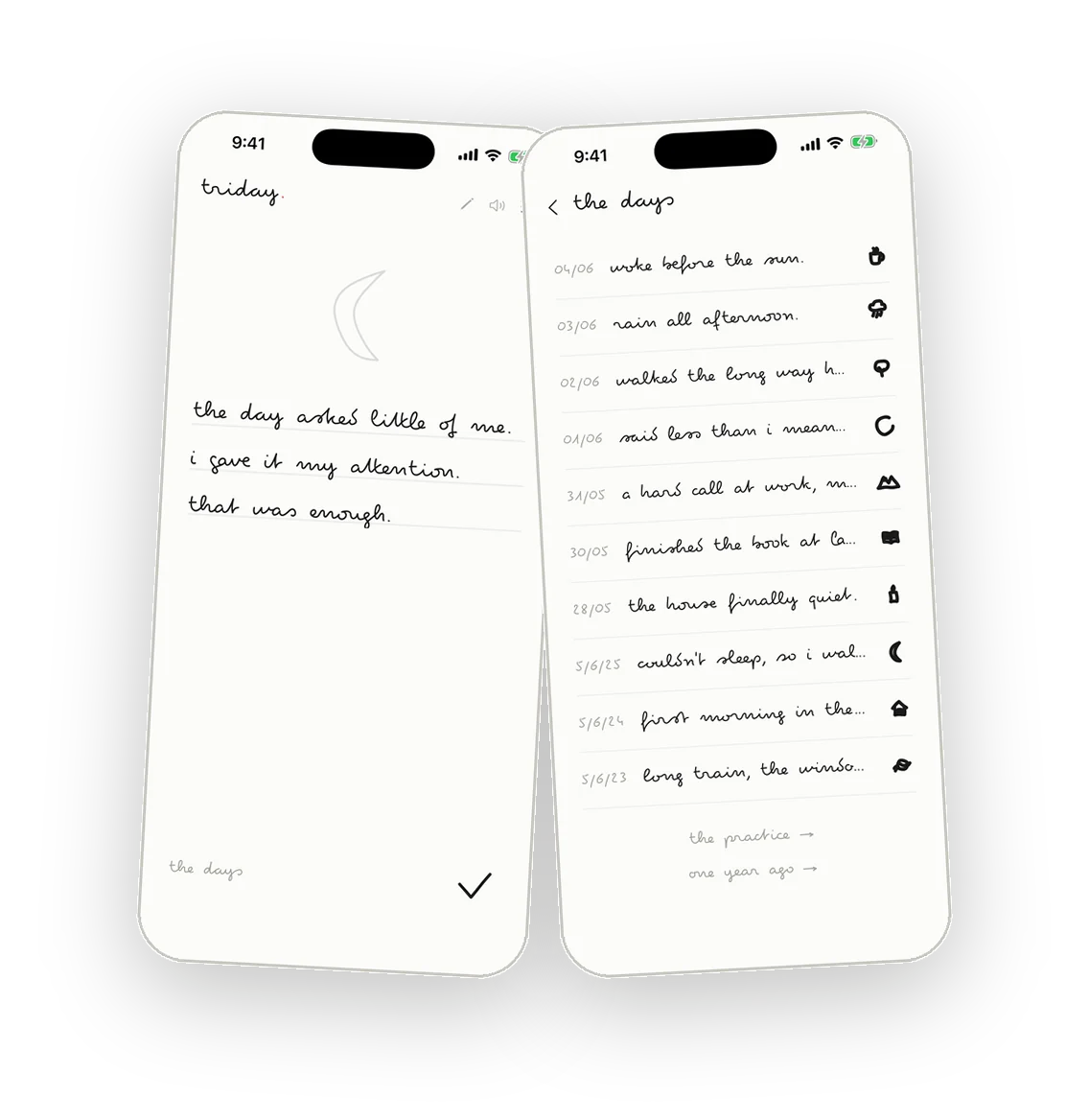
triday vs Daylio, head to head
| triday | Daylio | |
|---|---|---|
| the act | write three lines | tap a mood + activities |
| writing | the whole point | optional short note |
| charts / data | none | moods, trends, year in pixels |
| gamification | none | streaks, goals, achievements |
| price | $14.99/yr, ~$1.24/mo (core free) | $4.99/mo or $35.99/yr |
| one-time option | yes, $49.99 lifetime | no, subscription only |
| privacy | on device, no account | on device, no account too |
data about your days, or the days themselves
the difference is not which app is better; it is which question you are asking. Daylio answers "how have I been feeling lately?" with a chart, and it answers it well: tap a face and a few activity icons each day, and over weeks it shows you patterns you could not have seen otherwise. triday answers a different question, "what was today?", and it answers it with three written lines, because a mood icon cannot hold the thing your friend said, or the light at six, or why the day was actually hard. one turns your life into data you can graph. the other keeps a small, plain record of the days in your own words. most people who think they want one actually want the other, so it is worth knowing which you are after.
a mood is a number. a day is a sentence.
the part triday refuses
where the two genuinely conflict is gamification. Daylio leans into it: streaks to protect, goals to hit, achievements to collect, the satisfying grid filling in. for a habit tracker, that is a reasonable design, and it plainly works for a lot of people. but triday is built on the opposite conviction: that a reflective habit should not be a game you can lose. there is no streak to break, no badge to chase, no grid demanding to be completed. you write, or you do not, and nothing punishes the night you miss. the full case against streaks in a journal is here.
if what you actually want is to track your mood, Daylio is excellent and triday does not even try to compete: the tap-to-log speed, the charts, the trends over months, the year-in-pixels view are genuinely useful for spotting patterns, and the gamification keeps a lot of people logging who would otherwise stop. it is also, to its credit, local-first with no account required, so it is genuinely private. if you want mood and activity tracking with data you can see over time, choose Daylio. triday is for the different want: not to chart how you felt, but to write, in a few honest words, what the day was.
triday's answer
triday is a diary, not a tracker. it does not ask you to rate your mood or tap an activity, and it will never show you a graph of yourself, because the point is not to quantify the days but to keep them, in your own words, three lines at a time. it costs about $1.24 a month, a quarter of what Daylio charges for one, sits on your device, keeps no streak, and resurfaces your lines a year later so the days are not just logged but actually kept. if you want to measure your moods, Daylio is the better app. if you want to write your life down, plainly and briefly, that is the whole of what triday is for.
questions
is triday or Daylio better?
they do different jobs. Daylio is better if you want to track your mood and activities by tapping icons and seeing charts and trends, with very little writing. triday is better if you want to actually write a few lines about your day. one is a mood tracker; the other is a diary.
does Daylio have writing?
only a little. Daylio is built around tapping a mood and activity icons, with an optional short note. triday is built the other way around: writing three plain lines is the whole point, and there are no moods to tap or charts to fill.
is Daylio free?
Daylio has a free tier and a subscription, about $4.99 a month or $35.99 a year, for premium features. triday is free at its core; the full diary is $14.99 a year, about $1.24 a month, well under half of Daylio's bill, with a one-time $49.99 lifetime unlock if you would rather pay once.
does Daylio have streaks?
yes, and a lot of gamification: streaks, goals, achievements and a year-in-pixels grid. triday has none of it, by design, because a reflective habit should not be a game you can lose.
we keep an honest, dated comparison of the diary apps and name where a rival is the better tool. how we write & what we won't say →