a stoic app alternative, for people who just want the evening review
triday and Stoic begin in the same place, the stoic practice of going back over your day before sleep. they end in opposite places. here is the honest fork.
two thousand years ago Seneca described closing each day by going back over everything he had done and said, the practice he borrowed from his teacher Sextius. both triday and the Stoic app are built on that same nightly review. they part company on what to do with it. Stoic grew the review into a full mental-health platform: AI mentors, AI journaling, guided meditation, breathing exercises, CBT templates, mood tracking, courses. triday kept only the review itself, three honest lines about your day, and threw the rest away.
the short version: triday is a stoic app alternative built on only the evening review. three lines a day, no AI, kept on your device, about $1.24 a month instead of Stoic's $40-to-$100 a year. Stoic is the broader, more powerful app; triday is the smaller, quieter one, for people who wanted just the review.
so if you came to Stoic for the philosophy and found yourself paying a subscription for an AI wellness suite you did not want: triday is the stoic evening review with nothing bolted to it. no AI, no meditation modules, about $1.24 a month, billed $14.99 once a year, instead of Stoic's subscription (which reaches $69.99 to $99.99 a year at the AI tier), and everything kept on your device. this is not a takedown. Stoic is genuinely well made. it is a fork in values.
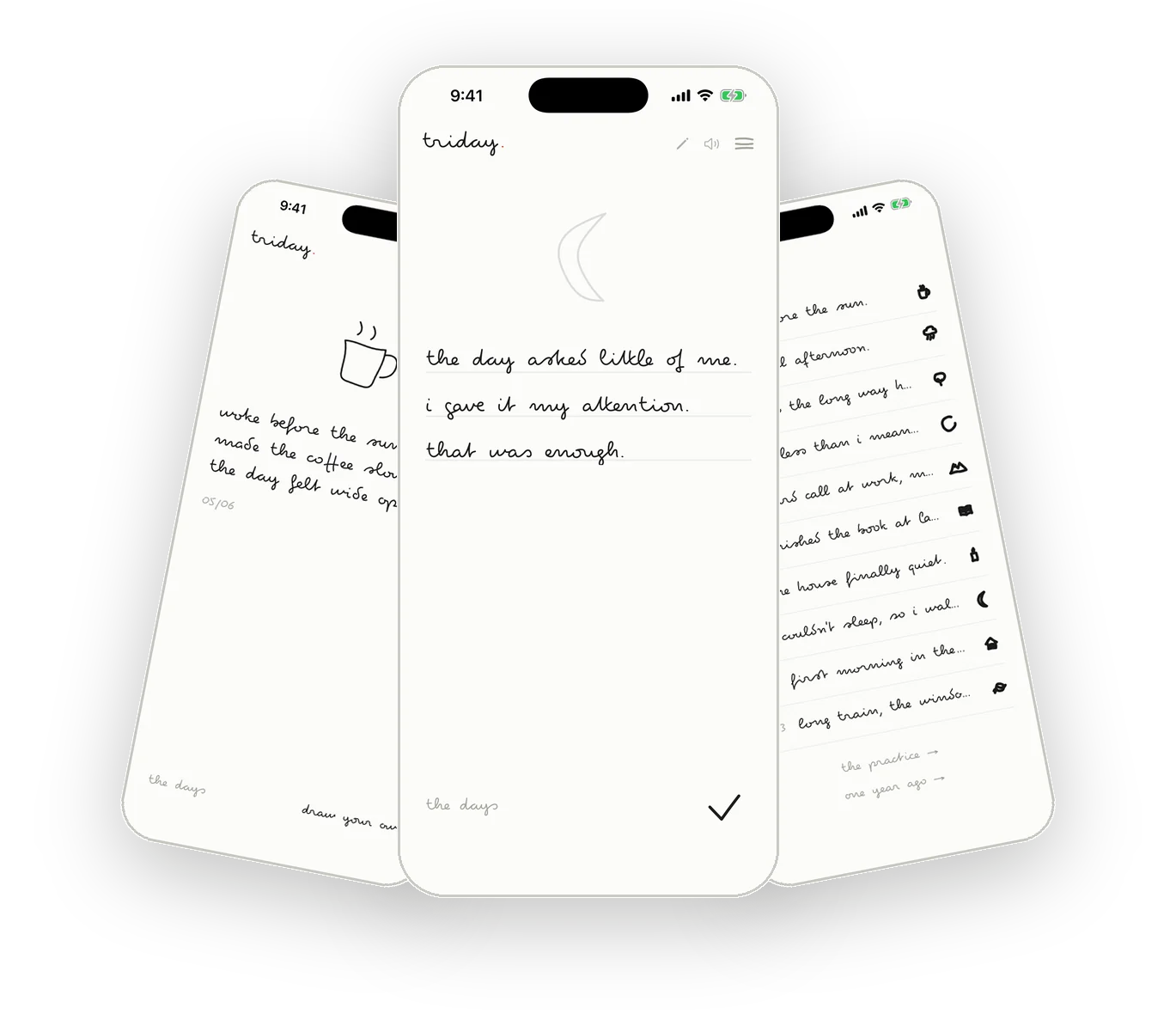
triday vs Stoic, head to head
| triday | Stoic | |
|---|---|---|
| the practice | three lines about your day, once | morning prep + evening review + more |
| AI | none, ever | AI mentors, AI journaling, "Dig Deeper" |
| price | $14.99/yr, ~$1.24/mo (core free) | $39.99/yr, up to ~$99.99/yr with AI |
| what else is in it | nothing | meditation, breathing, CBT, mood, courses |
| where it lives | on your device, no account | cloud, account, cross-platform |
| streaks / nudges | none | habit + mood tracking |
| platforms | iOS | iOS, Android, Mac, web, Watch |
the review, kept whole, vs the review as an on-ramp
the deepest difference is not a feature; it is what the evening review is for. in Stoic, the review is the doorway into a platform: do your reflection, and the app has meditation, breathing, a course, an AI mentor and a mood graph waiting on the other side. that is a coherent product, and for some people a welcome one. but if the nightly review was the only thing you wanted, you are now maintaining a wellness suite to reach it. triday makes the review the whole app. you open it, you write the three things that were your day, you close it, and there is nothing else to do, because there is nothing else there. Seneca did not need a mood graph. he needed a quiet few minutes and an honest look back. that practice, in plain language, is here.
stoicism was a way of paying attention, not a subscription to more features.
no AI, by design
Stoic's premium identity is increasingly its AI: AI mentors that answer you, AI journaling, "Dig Deeper" analysis that reads your entries, priced into the most expensive tier and metered with token packs. triday has none of it, and treats that as a line it will not cross, not a feature it is saving for later. the evening review is a conversation with yourself, in your own words; the moment a model joins it, it stops being that. if the AI is what drew you to Stoic, it is genuinely good and you should keep it. if the AI is what is pushing you away, here is the fuller case for a journal with no AI in it.
one purchase, not a standing charge
Stoic is subscription-only: about $6.99 a month or $39.99 a year for Premium, and $69.99 to $99.99 a year once you add the AI tier. for a practice you might keep for the rest of your life, that is a meter that never stops. triday's extras are a single $9.99 lifetime unlock, with the three-lines core free. a stoic would have something to say about renting your own self-examination by the month. the longer pay-once argument, and what a decade of subscriptions actually costs, is here.
on almost every axis except restraint, Stoic is the stronger product, and it would be dishonest not to say so. it has years of genuinely deep, well-written stoic content: structured courses, guided reflections, lessons. it bundles meditation, breathing, CBT-style thought work and mood graphs that triday does none of. it is cross-platform, where triday is Apple-only. it is an Apple Editors' Choice with millions of downloads and a polished design. and its AI, if you want one, will ask you a follow-up question when you freeze. if you want a complete daily mental-health practice in one app, or you value the AI reflection, choose Stoic. triday is only for the person who loved the evening review and wanted nothing else attached to it.
triday's answer
triday is the stoic evening review, made as small as it will go and left alone. three lines about what the day was, written by you, read by no one, stored on your phone, for about $1.24 a month, a fraction of Stoic's bill, or $49.99 once if you would rather never see a renewal. no AI, no meditation tab, no streak, no account. it is not trying to be a platform for your wellbeing. it is trying to be the quiet few minutes Seneca actually kept, and then to get out of your way. that is the whole of it, and for the right person, the whole is the point.
questions
is there a stoic app without AI?
yes. triday is a stoic-rooted evening-review app with no AI at all, by design and as a permanent line, where Stoic's premium tier is built around AI mentors and AI journaling that read your entries.
why is the Stoic app so expensive?
Stoic is a subscription: about $6.99 a month or $39.99 a year for Premium, climbing to roughly $69.99 to $99.99 a year once you add the AI tier. triday's full diary is $14.99 a year, about $1.24 a month, less than half of Stoic's cheapest year, its three-lines core is free, and a one-time $49.99 lifetime unlock is there if you would rather never pay again.
is the Stoic app subscription or one-time?
Stoic is subscription-only, billed monthly or yearly, with a separate higher AI tier. triday's full diary is $14.99 a year, about $1.24 a month, with a one-time $49.99 lifetime unlock as well, and the core practice is free.
does triday have meditation and breathing like Stoic?
no, and that is the honest trade. Stoic bundles guided meditation, breathing exercises, CBT-style templates, courses and mood tracking. triday is only the written evening review, three lines, and nothing else.
is triday or Stoic more private?
triday stores entries on your device with no account, no analytics, and no AI reading them. Stoic is a cloud-synced, multi-platform service whose AI features process your entries. if on-device privacy is the priority, triday is the stricter choice.
we keep an honest, dated comparison of the diary apps and say plainly where a rival is better. how we write & what we won't say →