triday vs Rosebud: an AI that reads your diary, or one that no one does
Rosebud is the best of the AI journals: a thoughtful model that reads what you write and answers. triday is the opposite promise, that no one reads it at all. it comes down to what you want a diary to be.
Rosebud is, by most accounts, the most thoughtful of the new AI journals. you write about your day and an AI reads it and answers: a good next question, a pattern it noticed across the weeks, the feeling of being heard at the end of a hard night. for people who want a reflective partner, it is genuinely well made, and we are not going to pretend it is not. but it asks something a diary has never asked before, that you let a model read the most private thing you write, and that is the whole of this comparison.
so, triday vs Rosebud: Rosebud is an AI that reads your entries and replies, stored in the cloud, on a roughly $108-a-year subscription; triday is three plain lines read by no one, kept on your device with no account, free at its core, with the full diary at about $1.24 a month, billed $14.99 once a year, a seventh of Rosebud's bill. Rosebud is the better fit if you want an AI to reflect with. triday is the better fit if you want a diary that stays unread. here is the difference, which is mostly a difference about who, or what, is in the room.
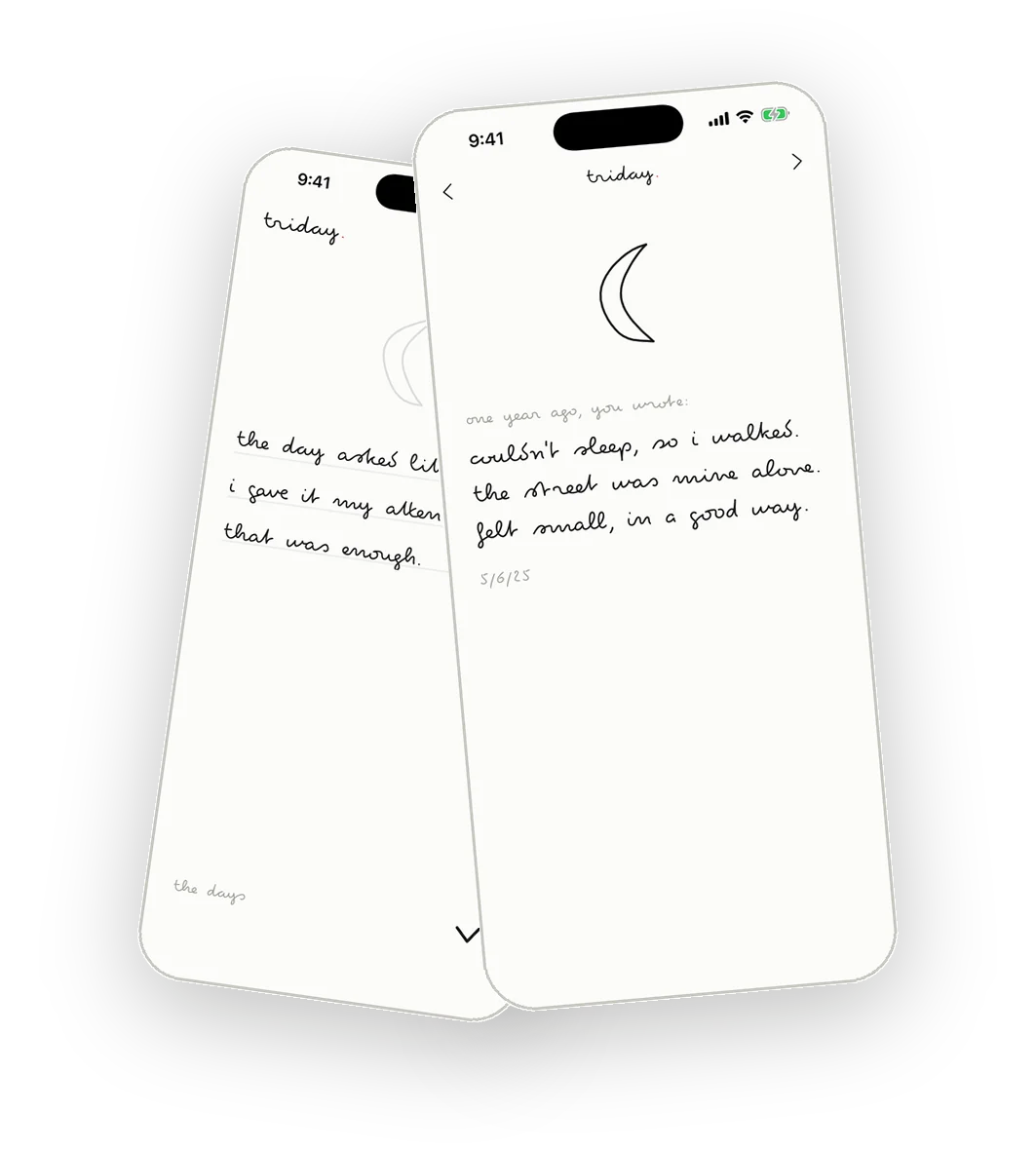
triday vs Rosebud, head to head
| triday | Rosebud | |
|---|---|---|
| the experience | three lines, read by no one | an AI reads and replies |
| AI | none | central: reads entries, answers, analyses |
| storage | on your device | cloud (encrypted, not end-to-end) |
| account | none | required |
| price | $14.99/yr, ~$1.24/mo (core free) | ~$12.99/mo or $107.99/yr |
| one-time option | yes, $49.99 lifetime | no, subscription only |
| what it is | a plain diary | a guided AI companion |
the question is who is in the room
everything else follows from one decision: whether you want a reader. Rosebud's whole value is that something reads your diary and responds, and if you want that, no plain app can match it. triday's whole value is that nothing does. a diary has always been the one place you write precisely because no one is reading, which is what lets the unguarded sentence out, and the moment a model joins, even a kind and capable one, you start, a little, to write for it. neither choice is wrong. but they are opposite choices, and you should make it on purpose rather than by default. the fuller case for a journal with no AI is here.
the most private sentence you will ever write is the one you were sure no one would read.
and then there is where it lives
the privacy gap is the widest of any comparison we keep. for an AI to read your entries, they have to leave your phone, to Rosebud's cloud, encrypted in transit and at rest but not, on the public record, end-to-end, behind an account, processed by a model. that may be a trade you are happy to make for what you get back. but for the single most sensitive document most people keep, it is a real one. triday is the far end of the other direction: entries on your device, no account, no servers that receive or read your writing, no AI, no analytics. nothing about your diary leaves your hand unless you turn on your own iCloud. on-device, no-account privacy has its own page.
if a reflective AI partner is genuinely what you want, Rosebud is the best one we have looked at, and triday offers nothing like it. its responses are thoughtful, its questions are good, its weekly analysis can surface things you would not have seen, and for someone going through a hard stretch alone, being heard, even by a model, at the end of the day is not nothing. if you want an AI to reflect with and you are comfortable with cloud storage and a subscription, choose Rosebud. triday is for the person who wants the older thing: a diary that is theirs alone, that no model has read, kept for the price of a single coffee, once.
triday's answer
triday is the diary with no one else in it. three honest lines about your day, written by you, stored on your phone, read by no model and no company, for about $1.24 a month; a whole year of it costs barely more than a single month of Rosebud. it cannot ask you a follow-up question or notice your patterns, and it does not want to, because the quiet of an unread page is not a missing feature; it is the feature. if you want a companion to reflect with, Rosebud is the better app, and an honest one. if you want the private room a diary has always been, with nothing reading over your shoulder, that is the whole of what triday is.
questions
is triday or Rosebud better?
it depends on whether you want an AI to reflect with. Rosebud is the better fit if you want an AI that reads your entries and responds like a thoughtful companion. triday is the better fit if you want a private diary that no model reads, kept on your device, for a seventh of the price.
does Rosebud read your journal entries?
yes, that is the product. Rosebud's AI reads what you write and replies, asks follow-up questions, and analyses your entries for patterns over time. triday has no AI and no servers that read your writing; your entries stay on your device.
how much does Rosebud cost?
Rosebud is a subscription, about $12.99 a month or $107.99 a year, with higher tiers above that and a limited free tier. triday is free at its core; the full diary is $14.99 a year, about $1.24 a month. a single month of Rosebud costs almost as much as triday's whole year, and a one-time $49.99 lifetime unlock is there if you would rather pay once.
is triday more private than Rosebud?
considerably. Rosebud stores your entries in the cloud and its AI reads them. triday keeps entries on your device with no account, runs no AI, and sends nothing to a server. for the most private diary, triday is the stricter choice.
we keep an honest, dated comparison of the diary apps and name where a rival is the better app. how we write & what we won't say →